
Best Peptide for Female Fat Loss: A 2026 Clinical Comparison
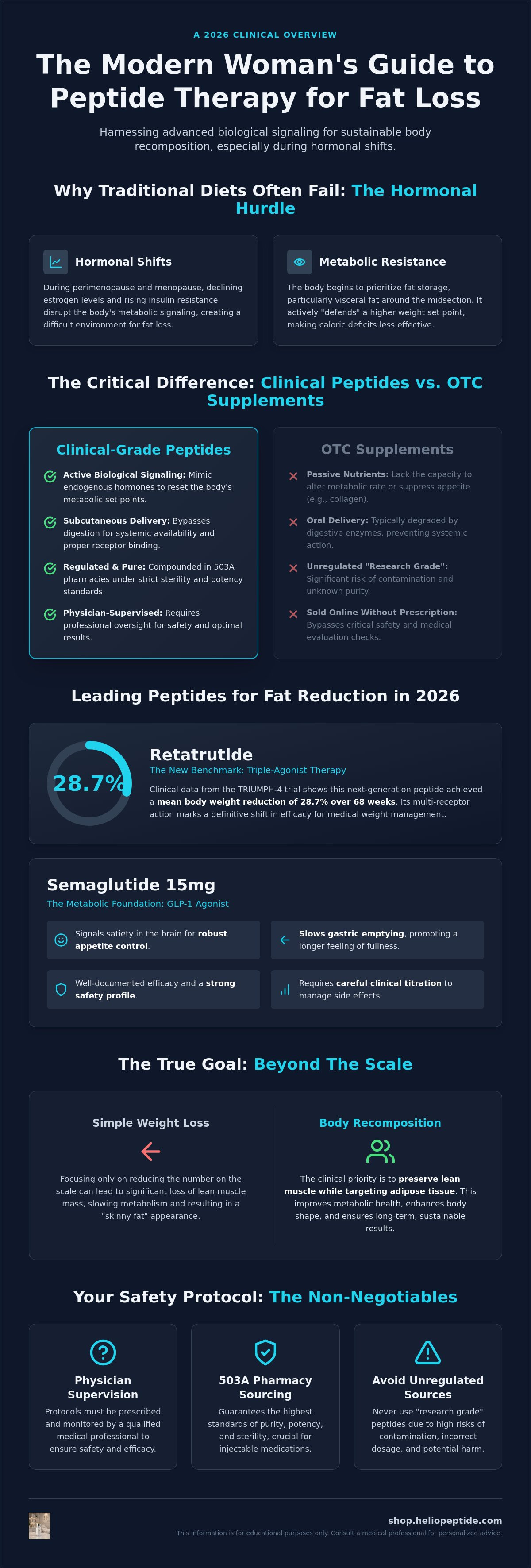
Clinical data from the TRIUMPH-4 trial in late 2025 revealed that triple-agonist therapies like Retatrutide achieved a mean body weight reduction of 28.7% over 68 weeks. This level of efficacy marks a definitive shift in how medical professionals identify the best peptide for female fat loss. For women navigating the hormonal shifts that lead to stubborn midsection weight, the priority has moved beyond simple caloric restriction toward sophisticated biological optimization.
You've likely felt the frustration of following traditional protocols only to lose muscle tone rather than actual adipose tissue. It's a valid concern that clinical interventions should address through muscle preservation and metabolic restoration rather than just rapid weight reduction. This article provides a 2026 clinical comparison of the most effective, physician-supervised peptides available today. We'll analyze the performance of agonists like Semaglutide and Retatrutide alongside growth hormone secretagogues to help you achieve sustainable results under a rigorous medical protocol.
Key Takeaways
- Understand how peptide signaling molecules address metabolic resistance caused by hormonal shifts during perimenopause and menopause.
- Evaluate the clinical efficacy of Semaglutide 15mg and the triple-agonist Retatrutide 10mg to determine the best peptide for female fat loss based on your biological profile.
- Prioritize body recomposition over simple weight loss by utilizing protocols that emphasize lean muscle preservation to avoid a "skinny fat" appearance.
- Identify the critical safety requirements of 503A compounding pharmacy standards and the necessity of physician-led oversight to ensure purity and potency.
- Learn to integrate advanced peptide therapy into a comprehensive wellness strategy focused on nutrient density and long-term metabolic health.
Understanding the Biology of Female Fat Loss and Metabolic Resistance
Peptides function as precision signaling molecules that orchestrate complex metabolic cascades. Unlike passive nutrients, these short chains of amino acids bind to specific cellular receptors to trigger targeted physiological responses, such as insulin sensitization or growth hormone release. For many women, identifying the best peptide for female fat loss requires moving beyond the outdated "calories in, calories out" model. Traditional caloric deficits often prove ineffective when the body's internal signaling is disrupted by aging or hormonal volatility. Clinical-grade peptides address this by modulating the hormonal set point, which is the weight range the body naturally defends through metabolic adaptation.
The Role of Hormonal Shifts in Fat Storage
The transition into perimenopause and menopause frequently results in a shift toward visceral fat deposition. This change is driven primarily by declining estrogen levels and a simultaneous rise in insulin resistance. When cells become less responsive to insulin, the body prioritizes fat storage over oxidation, creating a state of metabolic resistance. Integrating physician-supervised HRT often serves as a foundational step in these cases. By restoring hormonal equilibrium, HRT creates a permissive environment where metabolic agonists can function with maximum efficacy. This dual-track approach ensures that fat loss isn't just temporary, but a result of a fundamentally repaired metabolic environment.
Clinical Peptides vs. OTC Supplements
Significant confusion exists between nutritional peptides, such as collagen, and the class of anti-obesity medications known as metabolic agonists. While collagen provides structural support for connective tissues, it lacks the signaling capacity to alter metabolic rate or suppress appetite. Many over-the-counter products marketed as weight loss aids are simple oral amino acid blends that are degraded during digestion. Clinical efficacy requires subcutaneous delivery to ensure systemic availability and proper receptor binding. This distinction is critical for safety and results. Key differences include:
- Delivery Mechanism: Clinical peptides require subcutaneous administration to bypass digestive enzymes; oral supplements rarely achieve systemic signaling.
- Regulatory Standards: Professional-grade peptides are compounded in 503A pharmacies. These facilities must adhere to strict sterility and potency requirements.
- Biological Activity: Agonists like Semaglutide or Retatrutide actively mimic endogenous hormones to change biological set points.
Relying on unregulated "research grade" substances from online vendors introduces significant risks. These products often lack the purity necessary for human use and may contain contaminants that trigger inflammatory responses. True metabolic optimization requires high-register pharmaceuticals that are prescribed and monitored by medical professionals to ensure safety and long-term success.
The Top 3 Clinical Peptides for Targeted Fat Reduction in 2026
The selection of a therapeutic agent must be guided by the patient's metabolic baseline and specific body composition goals. While several molecules show promise, three specific peptides have emerged as the clinical standard in 2026. Identifying the best peptide for female fat loss often involves choosing between established GLP-1 mono-therapy and the newer generation of multi-receptor agonists. Each option offers a distinct mechanism for addressing the biological barriers to fat oxidation.
Semaglutide 15mg: The Metabolic Foundation
Semaglutide remains the primary baseline for clinical weight management due to its robust safety profile and well-documented efficacy. As a GLP-1 receptor agonist, it mimics the endogenous hormone responsible for slowing gastric emptying and signaling satiety within the central nervous system. Implementing a semaglutide 15 mg protocol allows for a high degree of appetite control while maintaining a manageable side effect profile. Clinical titration is essential to mitigate common gastrointestinal responses such as nausea or delayed motility. When administered under professional guidance, this therapy provides a stable foundation for metabolic restoration.
Retatrutide 10mg: The Triple-Agonist Evolution
For patients with refractory weight gain or those seeking more aggressive results, retatrutide 10mg represents the next stage of pharmacological evolution. This molecule targets three distinct pathways: GLP-1, GIP, and the Glucagon receptor. The addition of the Glucagon agonist is particularly significant for women. It stimulates thermogenesis and increases resting energy expenditure, effectively increasing the metabolic rate rather than solely suppressing intake. Phase 3 TRIUMPH-4 data confirmed that this triple-agonist approach can lead to a mean body weight reduction of 28.7% over 68 weeks. This makes it a powerful option for those who haven't responded sufficiently to single-agonist treatments.
Muscle Preservation and Body Recomposition
Rapid fat loss often carries the risk of sarcopenia, or muscle wasting, which can lead to a "skinny fat" appearance and a lowered basal metabolic rate. To counteract this, many protocols now incorporate Ipamorelin, a growth hormone secretagogue. Ipamorelin stimulates the pituitary gland to release natural growth hormone pulses, which prioritize the preservation of lean tissue during a caloric deficit. Research regarding GLP-1 Receptor Agonist Therapy and Exercise Training suggests that combining metabolic agonists with resistance protocols is the most effective way to optimize body composition. By stacking an agonist with a secretagogue, clinicians can target adipose tissue while supporting the structural integrity of muscle. This dual-action approach is frequently considered the best peptide for female fat loss when the goal is a toned, athletic physique.
Achieving these outcomes requires access to high-purity, lyophilized compounds that meet rigorous manufacturing standards. Patients can explore professional-grade options through Advanced Peptide Therapy solutions to ensure their protocol is supported by clinical-grade materials.
Choosing the Right Protocol: Weight Loss vs. Body Recomposition
Achieving a lower number on the scale is often prioritized over the quality of tissue lost, leading to the clinical phenomenon known as sarcopenic obesity, or "skinny fat." This state occurs when weight reduction is accompanied by significant lean muscle wasting, which ultimately compromises the basal metabolic rate (BMR) and creates a fragile metabolic profile. For many women, the best peptide for female fat loss isn't just a powerful agonist, but a strategically selected combination of agents that facilitate body recomposition. This distinction ensures that the aesthetic outcome matches the health improvements by maintaining a toned, athletic appearance rather than a depleted one.
The "Muscle Sparing" Strategy
Integrating growth hormone secretagogues like Ipamorelin or CJC-1295 is essential for maintaining BMR during aggressive weight reduction. These molecules stimulate endogenous growth hormone pulses, signaling the body to preserve lean mass while oxidizing adipose tissue. This strategy is supported by comparative clinical data; for instance, a study of Tirzepatide demonstrated that while high-potency agonists are exceptionally effective for mass reduction, the quality of that weight loss is significantly improved when the protocol includes muscle-sparing interventions. During any advanced peptide therapy, high protein intake and progressive resistance training are non-negotiable requirements. Professional monitoring through DEXA scans allows clinicians to adjust dosages based on actual tissue changes rather than total weight fluctuations, ensuring that the patient's structural integrity remains intact.
Semaglutide vs. Retatrutide: A Clinical Decision
Selecting the appropriate agonist depends on the patient’s metabolic history, baseline insulin sensitivity, and previous responses to weight loss interventions. Semaglutide is often the preferred starting point for patients with moderate metabolic resistance who value a well-established safety profile with predictable titration schedules. Conversely, Retatrutide is indicated for individuals with high metabolic resistance or those who have hit a plateau on single-receptor treatments. A detailed semaglutide vs retatrutide for weight loss comparison helps determine which protocol aligns with specific biological markers such as fasting glucose and lipid profiles.
Successful outcomes are a direct consequence of matching the potency of the triple-agonist with the patient's specific metabolic demands. While one patient may find the best peptide for female fat loss to be a conservative Semaglutide protocol that prioritizes appetite control, another may require the thermogenic boost of Retatrutide to overcome long-standing metabolic stalls. Physician-led assessment remains the only reliable method to identify these biological nuances and implement a protocol that delivers both aesthetic refinement and long-term metabolic health.
Sourcing and Safety: Why Physician Supervision and 503A Standards Matter
The pursuit of the best peptide for female fat loss must be predicated on pharmaceutical integrity. While the February 27, 2026, reclassification of key peptides to Category 1 has expanded legal access, it has also increased the prevalence of unregulated "research grade" materials. These substances are often synthesized in facilities that bypass the rigorous oversight required for human administration. Using non-clinical sourcing methods exposes patients to contaminants, incorrect dosages, and unpredictable biological reactions. True health optimization requires adherence to 503A compounding pharmacy standards, which mandate patient-specific prescriptions and validated sterility protocols as clarified by the FDA in April 2026.
A physician's role extends beyond the initial prescription; it involves a detailed screening for contraindications such as a personal or family history of medullary thyroid carcinoma or multiple endocrine neoplasia syndrome type 2. These clinical safety checks are absent when sourcing from direct-to-consumer retail platforms. Professional oversight ensures that the selected protocol aligns with the patient's unique metabolic profile and health history. Stability is another critical factor. Lyophilized, or freeze-dried, peptides represent the clinical standard for shelf life. Unlike pre-mixed liquid solutions that degrade rapidly, lyophilized powders maintain their molecular integrity until reconstituted for use, ensuring that the signaling molecules remain potent throughout the treatment cycle.
The Clinical Consultation Process
- Step 1: Metabolic Screening. A comprehensive review of medical history and current blood markers is conducted to identify insulin resistance or hormonal imbalances.
- Step 2: Precision Titration. The physician establishes a starting dose and gradually adjusts the protocol based on the patient's specific tolerance and fat loss velocity.
- Step 3: Clinical Monitoring. Ongoing assessment allows for the management of side effects and the adjustment of the stack to prioritize muscle preservation.
Identifying Quality Lyophilized Peptides
Maintaining molecular integrity requires a sophisticated manufacturing process known as lyophilization. This removes moisture from the peptide while it is frozen, preserving its structure for long-term storage. Patients should always verify the quality of their medication by reviewing a Certificate of Analysis (COA), which confirms the batch's purity and concentration. Understanding that the best online semaglutide program always includes clinical oversight is vital for achieving safe, sustainable results. Without this level of professional scrutiny, the risk of sub-therapeutic dosing or inflammatory responses increases significantly.
Patients seeking a secure and regulated environment for their metabolic transformation can access Advanced Peptide Therapy through our physician-led platform to ensure their protocol meets the highest clinical standards.
Integrating Peptide Therapy into a Comprehensive Wellness Strategy
Pharmacological intervention serves as a powerful catalyst for change, but it's most effective when viewed as a tool for metabolic re-education rather than a temporary fix. Utilizing the best peptide for female fat loss provides the biological leverage necessary to overcome resistance, yet long-term success depends on aligning these signals with supportive lifestyle choices. This phase of therapy focuses on shifting the body's homeostatic set point, allowing for a permanent transition to a higher state of metabolic efficiency. By integrating peptide therapy for weight loss with structured nutritional and behavioral protocols, patients can ensure that the adipose tissue reduction achieved is both sustainable and health-optimizing.
Nutrient density becomes a primary clinical priority during the use of GLP-1 agonists like Semaglutide or Retatrutide. Because these molecules significantly reduce total caloric intake through delayed gastric emptying and enhanced satiety, the biological value of every meal increases. Patients must prioritize high-quality protein and essential micronutrients to prevent deficiencies and support the muscle-sparing effects of secretagogues. Maintenance involves a methodical titration process where dosages are gradually reduced while the physician monitors for metabolic stability. This controlled exit strategy prevents the rapid weight rebound often associated with the abrupt cessation of unregulated weight loss aids.
Supportive Lifestyle Protocols
The efficacy of subcutaneous peptide therapy is deeply influenced by the patient's internal environment. Optimizing circadian rhythms is essential, as growth hormone release and metabolic repair are predominantly sleep-dependent processes. Maintaining a consistent sleep-wake cycle enhances the signaling capacity of growth hormone secretagogues. Proper hydration and electrolyte balance are also critical, as they facilitate the absorption of injected compounds and mitigate minor side effects like headaches or fatigue. New patients should anticipate that "Month One" focuses primarily on biological adjustment and inflammatory reduction, with significant fat oxidation accelerating as titration reaches therapeutic levels.
Next Steps: Your Clinical Consultation
Transitioning from education to action requires a formal medical assessment to determine the most appropriate protocol for your specific needs. Preparing for a telehealth appointment with Helio Peptide involves compiling a detailed medical history and identifying your primary objectives, whether they center on aggressive fat loss or body recomposition. It's helpful to review the clinical FAQ on weight loss injections to understand the nuances of administration and expected outcomes before your session. During the consultation, your physician will evaluate your metabolic markers to confirm which best peptide for female fat loss aligns with your endocrine profile, ensuring a protocol that is as safe as it is effective.
Professional health optimization is a disciplined journey defined by scientific rigor and expert oversight. Patients ready to initiate their protocol can access Advanced Peptide Therapy through our secure clinical platform, where every stage of the process is managed by licensed medical professionals committed to your long-term success.
Achieving Metabolic Restoration and Sustainable Results
Reclaiming metabolic control requires a definitive shift from superficial dieting to targeted biological signaling. The clinical comparison of the best peptide for female fat loss demonstrates that individual physiology must dictate the protocol, whether through the established reliability of Semaglutide or the thermogenic power of triple-agonists like Retatrutide. Safety remains the non-negotiable foundation of this transformation. By prioritizing 503A pharmacy standards and maintaining lean tissue through growth hormone secretagogues, you ensure that weight reduction is both metabolically sound and permanent.
Success is the inevitable result of matching sophisticated pharmaceutical tools with expert clinical guidance. Our comprehensive metabolic wellness programs are designed to provide the structure and safety necessary for long-term physical optimization. Begin Your Physician-Supervised Peptide Program Today to access high-purity, clinical-grade peptides under the direct oversight of US-licensed physicians. You have the opportunity to reset your metabolic expectations and achieve a state of lasting vitality through precise, science-based intervention.
Frequently Asked Questions
What is the best peptide for losing stubborn belly fat in women?
Retatrutide 10mg is currently the most effective clinical option for targeting stubborn visceral fat due to its triple-agonist mechanism. By activating GLP-1, GIP, and Glucagon receptors, it increases resting energy expenditure while suppressing appetite. This multi-pathway approach is often cited as the best peptide for female fat loss when dealing with refractory adipose tissue in the midsection that resists standard dietary interventions.
Can I take peptides for weight loss if I am in perimenopause?
Peptide therapy is highly effective for women in perimenopause, as it directly addresses the insulin resistance and metabolic slowing characteristic of this transition. Clinical protocols often integrate these agents with physician-supervised HRT to restore hormonal balance. This combination helps reset the metabolic set point, making it possible to overcome the weight loss plateau frequently experienced during hormonal shifts and aging.
Do peptides for fat loss cause muscle wasting?
Sarcopenia, or muscle wasting, is a potential risk during rapid weight loss if the protocol isn't properly managed. To mitigate this, many clinical programs incorporate growth hormone secretagogues like Ipamorelin to preserve lean tissue. Maintaining a high protein intake and engaging in resistance training are essential requirements to ensure that weight reduction comes from adipose tissue rather than functional muscle mass.
How long does it take to see results from female fat loss peptides?
Most patients observe an initial reduction in systemic inflammation and water retention within the first four weeks of therapy. Significant changes in body composition and visible fat loss typically manifest between months three and six as the dosage is titrated to therapeutic levels. Long-term metabolic restoration is a cumulative process that requires consistent adherence to the physician-led protocol over several months for peak efficacy.
Are there oral peptides that work as well as injections for fat loss?
Subcutaneous injections remain the clinical standard because oral peptides are largely degraded by digestive enzymes before they can reach systemic circulation. While some oral formulations exist, they often demonstrate significantly lower bioavailability and inconsistent signaling compared to injectable formats. For precise metabolic optimization and predictable results, physician-supervised subcutaneous delivery is the necessary method for ensuring molecular integrity and proper receptor binding.
Is it safe to stack multiple peptides for faster fat loss?
Stacking peptides is a common clinical strategy used to achieve body recomposition by targeting multiple biological pathways simultaneously. A typical stack might combine a GLP-1 agonist for appetite suppression with a growth hormone secretagogue for muscle preservation. This approach must be managed by a licensed physician to monitor for synergistic effects and ensure that the combination remains safe for the patient's specific metabolic profile.
What happens if I stop taking GLP-1 peptides after reaching my goal weight?
Abruptly stopping peptide therapy can lead to a metabolic rebound if the body hasn't established a new homeostatic set point. Clinical protocols emphasize a gradual titration downward while reinforcing metabolic re-education through nutrition and lifestyle adjustments. Maintenance of results depends on the patient's ability to sustain the metabolic improvements achieved during the active phase of the physician-supervised program through continued discipline.
How do I know if my peptide is coming from a legitimate 503A pharmacy?
A legitimate 503A compounding pharmacy requires a patient-specific prescription from a licensed medical provider and adheres to strict federal sterility standards. Patients should verify that their medication arrives with a professional label including their name and the pharmacy's credentials. You can also request a Certificate of Analysis to confirm the purity and potency of the lyophilized compound before beginning your protocol.
