
Semaglutide vs. Retatrutide for Weight Loss: A 2026 Clinical Comparison
The most established weight loss protocol might not be the most effective for your specific metabolic architecture. As clinical data from June 2026 emerges, the discussion regarding semaglutide vs retatrutide for weight loss has transitioned from simple calorie suppression to complex multi-receptor signaling. You likely recognize the initial efficacy of GLP-1 agonists, yet you may find yourself facing a frustrating plateau or concerned about the preservation of lean muscle mass during rapid fat reduction. These anxieties are common when utilizing standard protocols that do not account for the latest advancements in peptide science.
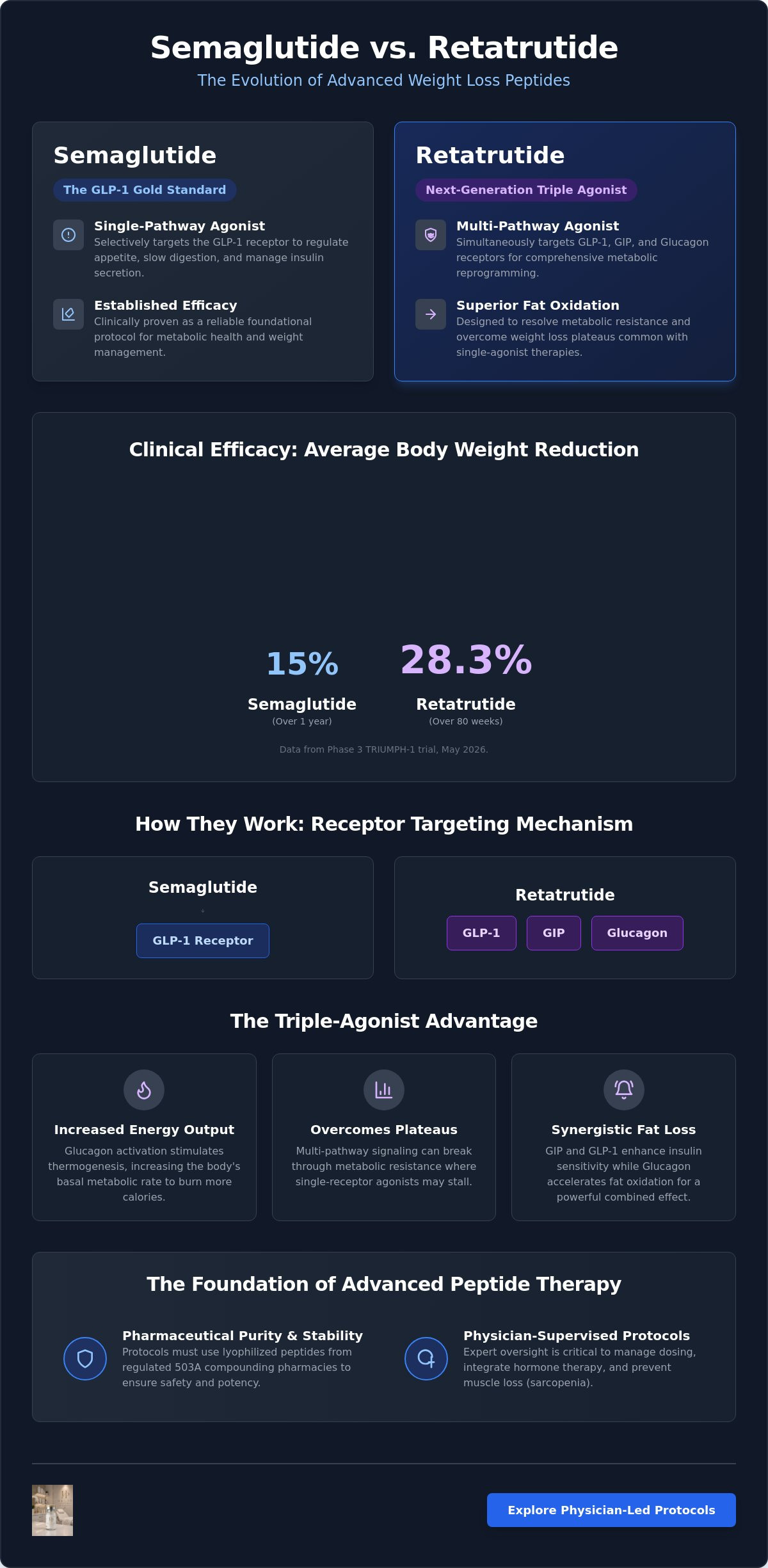
This analysis provides an authoritative medical comparison of single-pathway versus triple-agonist peptide protocols to help you optimize fat oxidation while maintaining physiological balance. We examine the Phase 3 TRIUMPH-1 data, which indicates that retatrutide can achieve an average body weight reduction of 28.3%, significantly exceeding the 15% benchmark established by semaglutide. You will gain a clinical understanding of how these molecules interact with GLP-1, GIP, and glucagon receptors to drive metabolic efficiency. We also address the current regulatory environment surrounding 503A compounding to ensure your transition to advanced therapy remains grounded in physician-led safety and pharmaceutical-grade purity.
Key Takeaways
- Examine the clinical transition from single-receptor GLP-1 agonists to triple-hormone agonists that target GLP-1, GIP, and glucagon receptors for superior metabolic signaling.
- Evaluate the efficacy gap in semaglutide vs retatrutide for weight loss, comparing the established 15% reduction against the 28.3% mean weight loss documented in recent Phase 3 trials.
- Understand the technical advantages of lyophilized peptide formulations and the clinical necessity of sourcing through regulated 503A compounding pharmacies to ensure pharmaceutical stability.
- Discover how physician-supervised protocols integrate hormone replacement therapy and TRT to address underlying metabolic barriers and prevent sarcopenia during rapid fat reduction.
- Identify the specific physiological criteria for transitioning from standard incretin mimetics to advanced, multi-pathway peptide protocols for long-term weight maintenance.
The Evolution of Incretin Mimetics: From Semaglutide to Retatrutide
Endocrine medicine has transitioned from basic caloric restriction to a sophisticated model of advanced hormonal signaling. This progression represents a fundamental shift in how clinicians manage chronic adiposity. While early treatments focused primarily on gastric emptying and central satiety, the clinical maturity reached in 2026 emphasizes comprehensive metabolic reprogramming. Analyzing the choice between semaglutide vs retatrutide for weight loss reveals the distinction between a reliable single-receptor strategy and a complex multi-pathway approach designed for peak physiological optimization.
Semaglutide: The Gold Standard of GLP-1 Therapy
Semaglutide functions as a selective GLP-1 receptor agonist. It replicates the action of the endogenous glucagon-like peptide-1 hormone, which regulates postprandial insulin secretion and slows gastrointestinal transit. This mechanism has established a robust clinical track record for both glycemic control and significant adiposity reduction. For many patients, semaglutide remains the foundational protocol. It offers a predictable safety profile and demonstrated efficacy, typically resulting in a total body weight reduction of approximately 15% over one year. Its role is that of a reliable stabilizer in metabolic health.
Retatrutide: Understanding Triple Agonism
Retatrutide represents a significant advancement as a first-in-class triple hormone receptor agonist. This molecule targets three distinct endocrine pathways: GLP-1, Gastric Inhibitory Polypeptide (GIP), and glucagon receptors. Integrating Retatrutide's triple-agonist mechanism allows for an aggressive resolution of metabolic resistance that single-pathway drugs often fail to address. While GLP-1 and GIP optimize insulin sensitivity and suppress appetite, the addition of glucagon receptor activation is transformative. It stimulates thermogenesis and increases energy expenditure directly at the cellular level. Data from the TRIUMPH-1 Phase 3 trial, which concluded in May 2026, demonstrated that this triple-agonist approach can achieve a mean weight reduction of 28.3% over 80 weeks. This shift toward multi-pathway therapy addresses the limitations of single-receptor agonists, especially for patients who've reached a weight loss plateau on standard GLP-1 protocols. The final clinical evaluation of semaglutide vs retatrutide for weight loss confirms that triple agonism provides a more potent tool for achieving comprehensive fat oxidation.
Metabolic Mechanisms: How These Peptides Signal Fat Loss
The efficacy of semaglutide vs retatrutide for weight loss is determined by the specific receptor affinities of each peptide. Semaglutide operates through high-affinity binding to the GLP-1 receptor, which primarily influences pancreatic insulin secretion and central nervous system satiety signals. In contrast, retatrutide functions as a balanced agonist across three distinct pathways. This broader signaling profile allows for more comprehensive metabolic control than single-ligand therapies. The complexity of these interactions is why clinicians must understand the underlying cellular communication rather than just the final weight loss percentage.
GIP (Gastric Inhibitory Polypeptide) plays a critical role in this triad by enhancing the insulin response to glucose while simultaneously improving the metabolic flexibility of fat cells. It acts as a buffer, ensuring that energy is processed efficiently rather than stored as adipose tissue. When GIP is combined with GLP-1 and glucagon, the result is a physiological synergy. This interaction explains why head-to-head clinical trial data often shows superior fat mass reduction in multi-agonist protocols. The combined effect is not merely additive; it represents a fundamental shift in metabolic signaling.
Glucagon's contribution is particularly significant for patients with low basal metabolic rates (BMR). While traditional incretin mimetics focus on reducing caloric input, glucagon signaling increases energy output through thermogenesis. This dual-action approach prevents the metabolic adaptation often seen during prolonged caloric restriction. Clinicians seeking to implement these precise signaling pathways often prioritize lyophilized peptide options for maximum biological activity and long-term stability.
Lipolysis and Adipose Tissue Targeting
These peptides differ in how they mobilize stored energy. Semaglutide focuses on systemic weight reduction, but the addition of glucagon and GIP signaling in triple-agonist protocols specifically targets visceral fat, which is the metabolically active fat surrounding internal organs. Triple receptor agonism creates a synergistic physiological environment where GLP-1 and GIP optimize insulin sensitivity while glucagon directly stimulates lipolysis within white adipose tissue. This targeted mobilization ensures that fat loss is prioritized over lean tissue depletion, maintaining a healthier body composition during the reduction phase.
Appetite Regulation vs. Energy Expenditure
The primary distinction in semaglutide vs retatrutide for weight loss lies in the balance between intake and expenditure. Semaglutide relies heavily on delayed gastric emptying and brainstem signaling to reduce hunger. It's a highly effective "brake" on caloric consumption. Retatrutide maintains this "brake" but adds an "accelerator" by increasing the body's resting energy expenditure. This shift directly challenges the "set point" theory of weight management, allowing the body to maintain a lower weight without the typical compensatory drop in metabolism that leads to plateaus.
Clinical Comparison: Efficacy, Dosing, and Side Effects
The clinical differentiation between semaglutide vs retatrutide for weight loss is most evident in the magnitude of total adiposity reduction. While semaglutide has long served as the industry benchmark with an average weight loss of up to 15% over 52 weeks, recent data from the TRIUMPH-1 Phase 3 trial completed in May 2026 has reset expectations. Participants on the highest dose of retatrutide achieved a mean body weight reduction of 28.3% at 80 weeks. This significant delta is attributed to the triple-agonist's ability to bypass the metabolic plateaus that often occur with single-pathway GLP-1 therapies. Selecting the appropriate protocol requires a detailed analysis of a patient's metabolic baseline and their previous response to incretin mimetics. Recent research on incretin receptor activity highlights how the varying affinities for GLP-1, GIP, and glucagon receptors dictate these clinical outcomes.
Dosing protocols for these peptides involve a methodical titration process to ensure patient tolerability. Standard clinical-grade options include Semaglutide 15 mg (3ml) and Retatrutide 10mg (3mL), both provided in lyophilized form to maintain peptide integrity. While semaglutide is typically titrated over several months to reach a maintenance dose, retatrutide's multi-receptor activity requires even more rigorous physician oversight to monitor the body's response to increased energy expenditure and glucagon signaling.
Efficacy and Weight Loss Trajectories
Weight loss trajectories differ significantly between these two protocols. Semaglutide users often experience rapid initial loss that gradually slows as the body's counter-regulatory mechanisms activate. Retatrutide appears to sustain a more consistent downward trajectory by addressing three metabolic pathways simultaneously. This makes it particularly effective for patients with metabolic syndrome who've failed to reach their goals on GLP-1 alone. To prevent sarcopenia during these rapid transitions, clinicians emphasize a high protein intake and structured resistance training. Preserving lean muscle mass is vital for maintaining a healthy basal metabolic rate once the reduction phase concludes.
Safety and Tolerability Protocols
The side effect profiles of these peptides share commonalities but diverge in specific physiological impacts. Gastrointestinal distress, including nausea and delayed gastric emptying, remains the primary concern for semaglutide. Retatrutide users may experience these GI symptoms but must also be monitored for heart rate variability and blood pressure changes due to glucagon receptor activation. Physician-led titration is the only reliable method to mitigate these adverse reactions. Regular clinical monitoring ensures that any transient increases in heart rate are managed safely while the patient's metabolic architecture adapts to the new signaling environment.
Pharmaceutical Integrity: Sourcing 503A Lyophilized Peptides
The clinical efficacy of any peptide protocol is inherently limited by the biochemical integrity of the molecule itself. When patients evaluate the merits of semaglutide vs retatrutide for weight loss, the discussion often centers on receptor affinity; however, the manufacturing standard is the true determinant of the physiological outcome. Pharmaceutical-grade peptides must be sourced from US-licensed 503A compounding pharmacies. These facilities operate under rigorous regulatory oversight to ensure that every vial meets exacting standards for sterility, potency, and purity. Utilizing unverified online vendors introduces significant risks that don't just hinder progress but can actively compromise your health.
Verification of quality is achieved through a Certificate of Analysis (COA) for every batch. This document confirms that the peptide has undergone high-performance liquid chromatography (HPLC) and mass spectrometry testing to verify its identity and purity levels. Any deviation from these standards can lead to unpredictable biological responses or systemic inflammation. Patients seeking to optimize their health must prioritize these clinical-grade standards to ensure their safety. Research-grade liquid peptides often lack these safeguards and carry specific risks:
- Molecular Degradation: Peptides in liquid form begin to break down immediately upon exposure to light and heat.
- Impurity Contamination: Lack of 503A oversight often results in the presence of heavy metals or residual solvents.
- Shear Stress: Physical agitation during shipping can easily damage the delicate amino acid chains in pre-mixed solutions.
- Inaccurate Dosing: Without batch-specific testing, the actual concentration of the peptide may vary significantly from the label.
The Science of Lyophilization and Stability
Lyophilization, or freeze-drying, is a sophisticated preservation process that removes water from the peptide while it is frozen under a vacuum. This technique is essential for maintaining the structural integrity of delicate amino acid chains. Liquid peptide formulations are highly susceptible to proteolytic degradation and are easily damaged by temperature fluctuations during transit. By remaining in a lyophilized state until the moment of use, the molecule remains biologically inert and stable. Proper handling involves gentle reconstitution with bacteriostatic water, ensuring the peptide is never shaken. Vigorous movement can shear the delicate molecular bonds and render the therapy ineffective.
503A Pharmacy Standards vs. The Gray Market
The "gray market" for research-grade peptides operates without the clinical safeguards required for human administration. A 503A designation signifies that the pharmacy is regulated by state boards and adheres to USP standards for sterile compounding. This oversight is what distinguishes a medical treatment from a chemical experiment. Helio Peptide maintains these rigorous standards by facilitating access to physician-led protocols and verified manufacturing. To ensure your metabolic optimization is supported by the highest level of pharmaceutical precision, you can order clinical-grade lyophilized peptides through our secure platform. This commitment to protocol ensures that your transition between different incretin mimetics is supported by molecules of unquestionable purity.
The Helio Peptide Protocol: Physician-Led Metabolic Optimization
Sustainable fat loss is not a transactional acquisition of medication but a consequence of precise endocrine management. Advanced peptide therapy requires rigorous physician oversight to ensure that metabolic signaling remains within safe physiological parameters. When evaluating semaglutide vs retatrutide for weight loss, a clinician must consider the patient's entire hormonal profile rather than simply prescribing a standard titration schedule. This level of oversight is essential to mitigate adverse reactions and to adjust dosages based on real-time physiological feedback. Helio Peptide operates as a specialized facilitator, ensuring that every protocol is grounded in clinical data and regulatory compliance. We move beyond generic dosing to create a framework for long-term metabolic health.
Personalized wellness programs address the unique metabolic architecture of each individual. A "one-size-fits-all" approach often ignores the subtle nuances of insulin sensitivity and nutrient partitioning that vary between patients. By monitoring specific biomarkers throughout the treatment cycle, physicians can identify the exact moment a protocol needs adjustment to avoid plateaus. This proactive management is what distinguishes a clinical protocol from a retail-oriented service. Long-term maintenance strategies are integrated into the initial phase of treatment, focusing on stabilizing the body's set point through gradual tapering and metabolic conditioning. This ensures that the physiological gains achieved during the reduction phase are maintained indefinitely.
Synergy with Hormone Replacement Therapy
Deficiencies in testosterone or estrogen often create a state of metabolic resistance that can diminish the efficacy of incretin mimetics. If the underlying hormonal foundation is fractured, even the most potent triple-agonist protocol may yield suboptimal results. Integrating TRT programs or physician-supervised HRT provides the necessary environment for peak metabolic performance. Testosterone acts as a critical protector of lean tissue. Utilizing TRT alongside advanced peptides helps prevent the muscle wasting often associated with rapid adiposity reduction. Restoring these vital levels ensures that the weight lost is primarily fat mass, preserving the basal metabolic rate and supporting long-term health optimization. This comprehensive approach addresses the root causes of adiposity rather than just the symptoms.
Starting Your Supervised Program
The transition to a professional-grade protocol begins with a comprehensive medical assessment. Every patient undergoes a telehealth consultation that includes a review of their medical history and detailed blood work. This diagnostic phase identifies potential barriers to weight loss, such as chronic inflammation or thyroid dysfunction, before a single dose is administered. Ongoing clinical support allows for the fine-tuning of your regimen as your body adapts to the new signaling environment. This methodical approach ensures that your results are a predictable outcome of scientific methodology. You can consult with a Helio Peptide physician to determine your optimal weight loss protocol and begin a program defined by pharmaceutical precision and expert guidance.
Optimizing Your Metabolic Architecture
The clinical landscape has evolved from basic appetite suppression to complex multi-pathway signaling. Choosing between semaglutide vs retatrutide for weight loss is a decision that's best made based on your specific metabolic resistance and long-term physiological goals. While semaglutide remains a robust foundation for many, the triple-agonist mechanism of retatrutide offers a potent alternative for those seeking to maximize fat oxidation through synchronized receptor activation. This transition requires more than just a prescription; it demands a comprehensive strategy that prioritizes muscle preservation and total hormonal synergy.
Success is a direct consequence of pharmaceutical integrity and professional oversight. All medications are sourced from FDA-regulated 503A pharmacies, providing you with clinical-grade lyophilized semaglutide and retatrutide for maximum potency. Our physician-supervised telehealth consultations ensure that your protocol is tailored to your unique biological needs, resolving hormonal barriers through a disciplined, medical approach. This scientific rigor transforms physical optimization into a sustainable reality. Explore Physician-Supervised Weight Loss Programs at Helio Peptide and take the first step toward restoring your metabolic health with confidence.
Frequently Asked Questions
Is Retatrutide more effective than Semaglutide for weight loss?
Clinical data indicates that retatrutide provides superior weight reduction compared to semaglutide due to its triple-agonist signaling. While semaglutide targets the GLP-1 receptor to achieve approximately 15% weight loss, retatrutide engages GLP-1, GIP, and glucagon receptors. This multi-pathway approach resulted in a 28.3% mean weight reduction in the TRIUMPH-1 Phase 3 trial. The choice between semaglutide vs retatrutide for weight loss depends on your metabolic history and previous response to single-receptor therapies.
What is the difference between a 503A pharmacy and a research peptide vendor?
A 503A pharmacy is a state-licensed facility that adheres to strict USP standards for sterile compounding and pharmaceutical purity. Research peptide vendors operate in a regulatory gray zone, selling substances labeled "not for human consumption" that lack clinical verification or sterility testing. Choosing a 503A source ensures that your medication is free from heavy metals and contaminants. This oversight is vital for maintaining patient safety during advanced peptide therapy.
Do I need a prescription to buy Retatrutide or Semaglutide online?
Yes, a valid prescription from a licensed physician is required to obtain these medications for clinical use. Physician-supervised programs ensure that your medical history, blood work, and metabolic markers are evaluated before starting therapy. This oversight is necessary to manage titration schedules and monitor for adverse reactions. Purchasing these peptides without a prescription from unverified sources carries significant health risks and lacks the safety of a regulated medical protocol.
Why should I choose lyophilized peptides over pre-mixed liquid options?
Lyophilized peptides are superior because the freeze-drying process preserves the structural integrity of the amino acid chains. Liquid formulations are highly unstable and begin to degrade immediately upon exposure to heat, light, or physical agitation during shipping. By choosing lyophilized options, you ensure that the molecule remains biologically inert until reconstitution. This stability is critical for maintaining the potency required to achieve predictable clinical outcomes in your weight loss protocol.
Can I switch from Semaglutide to Retatrutide if I hit a plateau?
Transitioning to retatrutide is a common clinical strategy for patients who've reached a weight loss plateau on single-receptor GLP-1 agonists. The addition of GIP and glucagon receptor agonism can re-stimulate fat oxidation and increase energy expenditure when the body has adapted to semaglutide. This switch must be managed by a physician to ensure a safe cross-titration. A supervised transition helps maintain metabolic momentum while minimizing the risk of increased side effects.
What are the most common side effects of Retatrutide 10mg?
The most frequently reported side effects at the 10mg dose include gastrointestinal distress such as nausea, vomiting, and constipation. These symptoms are typically transient and occur most often during the initial titration phase. Some users also report mild fatigue or skin sensitivity. Because retatrutide activates three hormonal pathways, the intensity of these reactions can vary. Physician-led dosing adjustments are the most effective way to manage these symptoms while your metabolic architecture adapts.
How does Retatrutide affect heart rate compared to Semaglutide?
Retatrutide may cause a more pronounced increase in resting heart rate than semaglutide due to its activation of the glucagon receptor. While both peptides can influence the autonomic nervous system, glucagon signaling directly affects cardiac chronotropy. Clinical trials have documented transient increases in heart rate that typically stabilize over time. It's essential to monitor cardiovascular markers during therapy. This differentiation is a key factor when comparing semaglutide vs retatrutide for weight loss in patients with pre-existing conditions.
Will I lose muscle mass while taking fat loss peptides?
Rapid fat reduction carries an inherent risk of lean tissue loss, often referred to as sarcopenia. You can mitigate this by prioritizing high protein intake and consistent resistance training throughout your protocol. In some cases, physicians may integrate TRT or other hormonal support to protect muscle mass while the peptides drive fat oxidation. Maintaining muscle is vital for sustaining a healthy basal metabolic rate and ensuring long-term success after you complete the reduction phase.
