
Clinical Peptide Stacking for Weight Loss: A Medical Framework for 2026
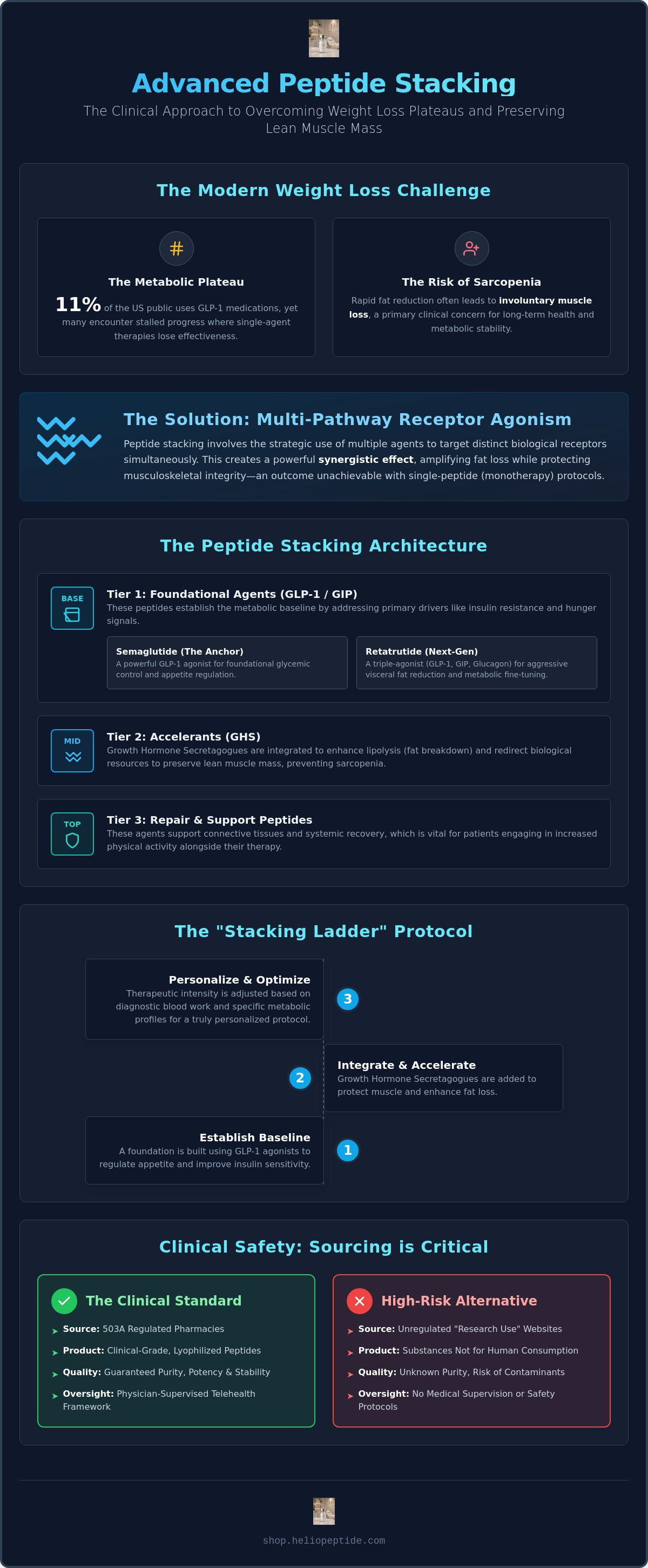
As of July 2026, 11% of the United States public utilizes GLP-1 medications for weight management, yet many encounter metabolic plateaus that necessitate an advanced approach like peptide stacking for weight loss. You've likely recognized that achieving an optimal body composition requires more than simple caloric restriction. The risk of sarcopenia, or the involuntary loss of lean muscle mass during rapid fat reduction, remains a primary clinical concern for those seeking a sustainable and healthy transformation.
This article details the scientific framework for these combined protocols, a method designed to optimize metabolic pathways through the strategic alignment of therapeutic agents. You'll gain a clear understanding of how clinical synergy protects musculoskeletal integrity while aggressively targeting visceral adipose tissue. We'll examine the specific roles of lyophilized peptides like Semaglutide and Retatrutide, the critical importance of sourcing from 503A regulated pharmacies, and the protocols required for safe, physician-led administration in a complex regulatory environment.
Key Takeaways
- Understand how multi-pathway receptor agonism addresses metabolic resistance by targeting distinct cellular processes simultaneously.
- Learn to establish a baseline for peptide stacking for weight loss using GLP-1 foundationals while integrating growth hormone secretagogues to protect musculoskeletal integrity.
- Discover the "Stacking Ladder" protocol for personalizing therapeutic intensity according to diagnostic blood work and specific metabolic profiles.
- Differentiate between the risks of unregulated "research use" substances and the safety standards of clinical-grade lyophilized medications sourced from 503A pharmacies.
- Gain insight into the physician-supervised telehealth framework required for maintaining regulatory compliance and ensuring accurate reconstitution and dosage.
The Science of Peptide Stacking for Metabolic Optimization
Clinical peptide stacking for weight loss represents a sophisticated evolution in metabolic medicine. It involves the strategic administration of multiple amino acid chains designed to target distinct biological receptors simultaneously. Rather than relying on a single pathway, this approach leverages the principle of receptor agonism. Peptides function as signaling molecules that "unlock" specific cellular processes, such as insulin regulation or the release of endogenous growth hormone. By engaging multiple receptor sites, clinicians can orchestrate a more comprehensive metabolic response than is possible with monotherapy.
Single-agent protocols often encounter a "ceiling effect," where increasing the dosage no longer yields proportional fat loss but does increase the risk of adverse side effects. Stacking bypasses this plateau by activating complementary pathways. To ensure these complex signals reach their intended targets, the use of clinical-grade lyophilized peptides is essential. Lyophilization, or freeze-drying, preserves the molecular integrity and stability of the peptide chain, ensuring that the biochemical potency remains intact from the pharmacy to the point of administration.
Synergy vs. Redundancy in Peptide Combinations
Effective stacking requires a deep understanding of biochemical "cross-talk" between physiological systems. Combining two peptides that utilize the same mechanism of action is counterproductive; it increases the metabolic load without improving the therapeutic outcome. True synergy occurs when agents like Glucagon-like peptide-1 (GLP-1) agonists, which manage satiety and glucose, are paired with growth hormone secretagogues that preserve lean tissue. Metabolic synergy is the amplification of weight loss through multi-pathway targeting.
Biological Pathways: Beyond Simple Appetite Suppression
While many patients focus solely on hunger signals, professional protocols address the broader spectrum of metabolic health. This includes the distinction between lipolysis, the breakdown of stored triglycerides, and thermogenesis, the process of calorie burning through heat production. Stacking allows for the concurrent optimization of nutrient partitioning, where the body is signaled to prioritize muscle preservation while utilizing fat stores for energy. This multi-faceted approach effectively addresses the hormonal triggers that often lead to weight regain after traditional dieting, creating a more stable physiological environment for long-term maintenance.
Primary Peptide Categories in Weight Loss Stacks
Clinical protocols for peptide stacking for weight loss prioritize a tiered architecture. Physicians typically designate GLP-1 and GIP agonists as foundational agents because they address the primary drivers of metabolic dysfunction, such as insulin resistance and dysregulated hunger signals. Once the metabolic baseline is established, secondary categories like Growth Hormone Secretagogues (GHS) function as accelerants. These auxiliary agents don't just speed up fat loss; they redirect biological resources to maintain structural integrity. This is particularly vital for patients engaging in increased physical activity, where repair peptides support the connective tissues and systemic recovery necessary to sustain a high-performance lifestyle. It's a method that requires precision, as mixing potent biological agents demands rigorous physician oversight to ensure systemic balance.
GLP-1 Agonists: The Foundation (Semaglutide and Retatrutide)
Semaglutide 15 mg serves as the clinical anchor for most stacking protocols due to its established efficacy in glycemic control and appetite regulation. However, the field has progressed toward multi-receptor targeting to overcome metabolic adaptation. Retatrutide 10mg represents the next generation of therapy, acting as a triple agonist that engages GLP-1, GIP, and glucagon receptors. This expanded receptor profile, as discussed in this scientific review on peptides for obesity, facilitates a more profound impact on lipid metabolism and thermogenesis. While semaglutide provides foundational weight loss, triple-agonists like retatrutide allow for metabolic "fine-tuning" in patients who require more aggressive intervention for visceral fat reduction.
Growth Hormone Secretagogues (GHS) and Metabolic Accelerators
To mitigate the risk of sarcopenia during rapid weight loss, Growth Hormone Secretagogues (GHS) are often integrated into the stack. These agents, including CJC-1295 and Ipamorelin, stimulate the pituitary gland to release endogenous growth hormone in a natural "pulse" pattern. This hormonal surge is critical for nutrient partitioning, ensuring that the body preserves lean muscle mass while oxidizing fat stores for energy. The timing of these injections is paramount; GHS administration is typically scheduled to align with natural circadian rhythms to maximize the metabolic pulse effect. By combining these with foundational agents, patients can achieve a more aesthetically favorable body composition rather than just a lower number on the scale. Those seeking to optimize their results should view our clinical-grade options to ensure they're using stable, lyophilized formulations.
Strategic Stacking Protocols: Matching Peptides to Metabolic Profiles
A standardized approach to peptide stacking for weight loss is clinically insufficient. Each protocol must be precisely calibrated based on a patient's diagnostic blood work and baseline body composition. This ensures that the intervention addresses specific hormonal deficiencies rather than applying a generic solution. The "Stacking Ladder" provides a structured methodology for this escalation. Patients typically begin with a foundational GLP-1 agent to establish glycemic control before auxiliary peptides are introduced to address secondary metabolic objectives. This methodical progression allows the clinician to monitor tolerance and efficacy at each stage.
Strategic implementation also requires a planned "cycling" phase for specific agents. Continuous stimulation of the same biological pathways can lead to receptor desensitization, where the body's response to the peptide diminishes over time. By rotating or pausing certain elements of the stack, physicians maintain the therapeutic "edge" and prevent metabolic adaptation. This level of complexity underscores why medical supervision is mandatory; without it, patients often face the dangers of unregulated peptide stacking, which can lead to systemic hormonal imbalances. For a comprehensive look at how these agents function individually, refer to our guide on Peptide Therapy for Weight Loss.
The Fat-Loss and Lean Muscle Retention Stack
The primary risk of rapid weight reduction is the loss of metabolically active lean tissue. To mitigate this, clinicians often pair GLP-1 agonists with Growth Hormone Secretagogues (GHS). This combination maintains a positive nitrogen balance even during a significant caloric deficit. By protecting the musculoskeletal system, the protocol avoids the "skinny fat" aesthetic often associated with aggressive dieting. Muscle preservation serves as the fundamental biological insurance policy against the metabolic slowing that leads to weight regain.
The Insulin Sensitivity and Glucose Management Stack
Patients with long-term obesity frequently exhibit metabolic inflexibility, where the body struggles to switch between burning glucose and stored fat. Protocols in this category focus on mitochondrial efficiency and nutrient partitioning. Pairing foundational agents with peptides that regulate Gastric Inhibitory Polypeptide (GIP) can significantly alter fat storage patterns. These stacks work to restore the body's ability to process nutrients effectively, moving beyond simple weight loss toward a state of genuine metabolic restoration.
Clinical Safety Standards and Risk Mitigation in Stacking
Implementing a protocol for peptide stacking for weight loss requires more than just biological knowledge; it demands a rigorous safety framework. Cumulative side effects like persistent nausea, hypoglycemia, or localized injection site reactions can occur when multiple metabolic pathways are stimulated simultaneously. These risks are often compounded when patients attempt to manage their own dosing without professional oversight. A structured clinical approach ensures that the metabolic load remains within safe physiological limits while maximizing the therapeutic benefits of the stack.
Before initiation, comprehensive blood panels measuring HbA1c, IGF-1, and thyroid function are non-negotiable requirements. These markers provide the baseline necessary to monitor how the body responds to advanced peptide therapy and allow for real-time adjustments to the stack. Without this data, clinicians cannot accurately assess the impact of these agents on systemic health or endocrine balance. Ongoing monitoring is the only reliable method to mitigate long-term risk and ensure the protocol remains aligned with the patient's evolving metabolic profile.
Managing Cumulative Side Effects and Tachyphylaxis
Tachyphylaxis occurs when receptors become less responsive to a stimulus due to over-saturation or chronic exposure. It's the primary reason why "more" is rarely "better" in a clinical setting. To maintain receptor health and prevent metabolic adaptation, physicians utilize precise dose titration and scheduled breaks. This methodical approach is supported by specific hydration and nutritional protocols designed to stabilize blood glucose levels and support the high-performance demands of a multi-peptide stack. Proper support helps maintain the efficiency of the cellular signaling process over the entire duration of the program.
The Critical Role of 503A Pharmacy Sourcing
The distinction between "research chemicals" and clinical-grade medications is a matter of patient safety and regulatory compliance. A 503A pharmacy is a state-licensed facility that complies with stringent USP standards for compounding. These regulated environments ensure the purity, sterility, and exact concentration of the lyophilized product. Gray market sourcing often involves impurities or incorrect concentrations that can lead to unpredictable biological responses. This is why the best online semaglutide program must be anchored to a verified 503A pharmacy network to guarantee molecular stability.
To ensure your protocol meets these medical standards and utilizes only regulated formulations, access our physician-supervised sourcing platform.
Implementing a Physician-Supervised Peptide Program
The transition from theoretical understanding to practical application requires a structured clinical pathway. A physician-supervised program begins with a comprehensive diagnostic evaluation, where the patient's metabolic baseline is established through blood chemistry and body composition analysis. This diagnostic stratification ensures that peptide stacking for weight loss isn't a matter of trial and error but a targeted medical intervention tailored to specific hormonal profiles. Once a protocol is initiated, the physician's role shifts to continuous longitudinal monitoring, where dose adjustments are made based on real-time physiological feedback and tolerance levels. It's an iterative process that positions the patient as an active participant in their own metabolic restoration, moving away from passive treatment toward a model of disciplined health optimization.
Telehealth Integration and Ongoing Clinical Monitoring
Digital health platforms have revolutionized the accessibility of specialized medical expertise, bridging the gap between clinical excellence and patient convenience. Telehealth integration ensures safety through regular, high-frequency check-ins and structured reporting, allowing for the immediate identification of potential side effects or metabolic plateaus. For many patients, the convenience of managing physician-supervised HRT programs alongside weight loss protocols creates a cohesive strategy for systemic body optimization. Professional oversight is non-negotiable for complex stacking protocols; the precise nature of peptide reconstitution and subcutaneous administration requires a level of guidance that only a trained clinician can provide. This ensures that every milligram administered contributes directly to the desired therapeutic outcome without compromising systemic homeostasis.
Personalised Wellness Pathways at Helio Peptide
Helio Peptide maintains a steadfast commitment to 503A pharmacy standards and clinical rigor. Every protocol is anchored in the use of high-purity, lyophilized formulations, ensuring that the biochemical integrity of the peptides isn't compromised by improper manufacturing or storage conditions. Transitioning from initial interest to a supervised medical protocol is a streamlined process defined by transparency, professional accountability, and a focus on long-term outcomes. The ultimate objective extends beyond the scale. We focus on metabolic independence and healthspan optimization, providing patients with the tools and oversight necessary to achieve a state of lasting physiological balance. Results are the inevitable consequence of this scientific methodology, ensuring that peak performance is both achievable and sustainable.
Advancing Toward Metabolic Excellence in 2026
Clinical success in the coming year is defined by the strategic transition from simple weight reduction to comprehensive body recomposition. By leveraging the synergistic effects of multi-pathway receptor agonism, patients can effectively overcome plateaus while maintaining the lean tissue necessary for a high-functioning metabolism. It's clear that peptide stacking for weight loss requires a foundation of pharmaceutical-grade stability and rigorous medical oversight to remain both safe and effective. Utilizing clinical-grade lyophilized peptides sourced exclusively from FDA-regulated 503A pharmacies ensures that every protocol meets the highest standards of purity and potency.
Helio Peptide facilitates this transition through physician-supervised telehealth programs designed to monitor your progress and adjust dosages with medical precision. This professional framework removes the uncertainty of unregulated sourcing and provides a clear, data-driven path toward metabolic restoration. You don't have to navigate these complex biological pathways alone. Consult with a Helio Peptide physician to design your personalised stacking protocol and begin your journey toward sustainable physical optimization. Achieving your health objectives is a direct consequence of scientific methodology and expert guidance.
Frequently Asked Questions
Is it safe to stack Semaglutide with other peptides for weight loss?
Stacking is safe only when managed by a licensed clinician who can monitor for drug-drug interactions and cumulative toxicity. While combining agents can enhance results, it also increases the physiological load on the body. Physician oversight ensures that the protocol remains within safe metabolic boundaries and that dose adjustments are made based on your specific tolerance levels.
What are the best peptides to stack with GLP-1s for muscle preservation?
Growth Hormone Secretagogues (GHS) such as CJC-1295 and Ipamorelin are the primary agents used alongside GLP-1s to maintain musculoskeletal integrity. These peptides promote lean tissue preservation by signaling the pituitary gland to release natural growth hormone pulses. This mechanism helps prevent the muscle wasting often associated with rapid weight reduction and caloric deficits.
Do I need a prescription for peptide stacking protocols?
Legitimate peptide stacking for weight loss requires a medical prescription from a licensed healthcare provider. This requirement serves as a safety gatekeeper, ensuring that patients undergo necessary diagnostic screening before starting therapy. It also guarantees that the medications are dispensed by regulated 503A pharmacy entities rather than unregulated gray market sources.
What is the difference between 503A pharmacy peptides and research peptides?
The primary difference lies in regulatory oversight and manufacturing purity. 503A pharmacies are state-licensed and FDA-regulated facilities that must adhere to strict sterile compounding standards. Conversely, research peptides are sold as chemicals not intended for human consumption; they lack any guarantee of purity, sterility, or molecular concentration, posing significant health risks.
How long does it take to see results from a peptide stack?
Most patients begin to notice changes in satiety and energy levels within the first 14 to 21 days of starting a protocol. Measurable changes in body composition through peptide stacking for weight loss typically manifest after 8 to 12 weeks of consistent adherence. Individual timelines vary based on baseline metabolic health and the specific intensity of the stack.
Can peptide stacking cause more side effects than single-agent therapy?
Combining multiple therapeutic agents can increase the incidence of gastrointestinal distress or localized injection site reactions. Because stacking targets several metabolic pathways at once, the potential for cumulative nausea or hypoglycemia is higher than with monotherapy. Precise clinical titration and ongoing monitoring are essential to mitigate these systemic risks effectively.
How do I reconstitute lyophilized peptides for a stack?
Reconstitution is the process of mixing lyophilized powder with a sterile diluent, typically bacteriostatic water, to create an injectable solution. The volume of diluent used determines the final concentration and dosage of the medication. This procedure must be performed with aseptic technique following the exact mathematical ratios provided by your prescribing physician.
Is physician supervision required for peptide therapy in 2026?
Medical supervision remains a critical requirement for any advanced peptide program in 2026. Licensed professionals provide the necessary diagnostic baseline and ongoing monitoring to ensure the protocol is both effective and safe for the patient. This oversight protects individuals from the hormonal imbalances and complications often caused by unregulated self-administration.
