
Retatrutide 10mg: Clinical Applications of the Triple-Agonist Peptide in 2026
30.3% of total body weight loss is no longer a theoretical projection; it is a documented clinical outcome for patients utilizing the highest tiers of triple-agonist therapy. Many patients currently find themselves stalled on standard GLP-1 or dual-agonist protocols, reaching a metabolic plateau that feels impossible to breach. For those seeking to optimize their physiological performance, retatrutide 10mg represents the next evolution in peptide science. This first-in-class "triple G" agonist targets the GLP-1, GIP, and glucagon receptors, offering a potent mechanism for metabolic restoration that transcends previous therapeutic limits.
This clinical analysis explores the biochemical advantages of retatrutide and the necessity of physician-led protocols. You'll gain clarity on the essential standards of 503A pharmacy sourcing, which separates professional-grade solutions from the uncertainty of research chemicals. We will examine the specific requirements for reconstitution, stable dosing, and the regulatory framework governing these advanced programs in 2026. This guide ensures you have the technical knowledge required to transition from generic options to a secure, medically supervised peptide strategy.
Key Takeaways
- Understand the unimolecular triple-agonist mechanism that targets GLP-1, GIP, and glucagon receptors to overcome metabolic plateaus.
- Analyze the clinical data supporting the use of retatrutide 10mg, which demonstrates superior weight reduction outcomes compared to previous generations of dual-agonist therapy.
- Differentiate between 503A clinical-grade sourcing and "research-only" compounds that don't meet pharmaceutical safety standards for human use.
- Learn the professional protocol for accessing physician-supervised programs, including the metabolic screening required for advanced peptide therapy.
- Evaluate the metabolic efficiency and side-effect profiles of this third-generation peptide compared to traditional single and dual-agonist options.
Understanding the Retatrutide 10mg Triple-Agonist Mechanism
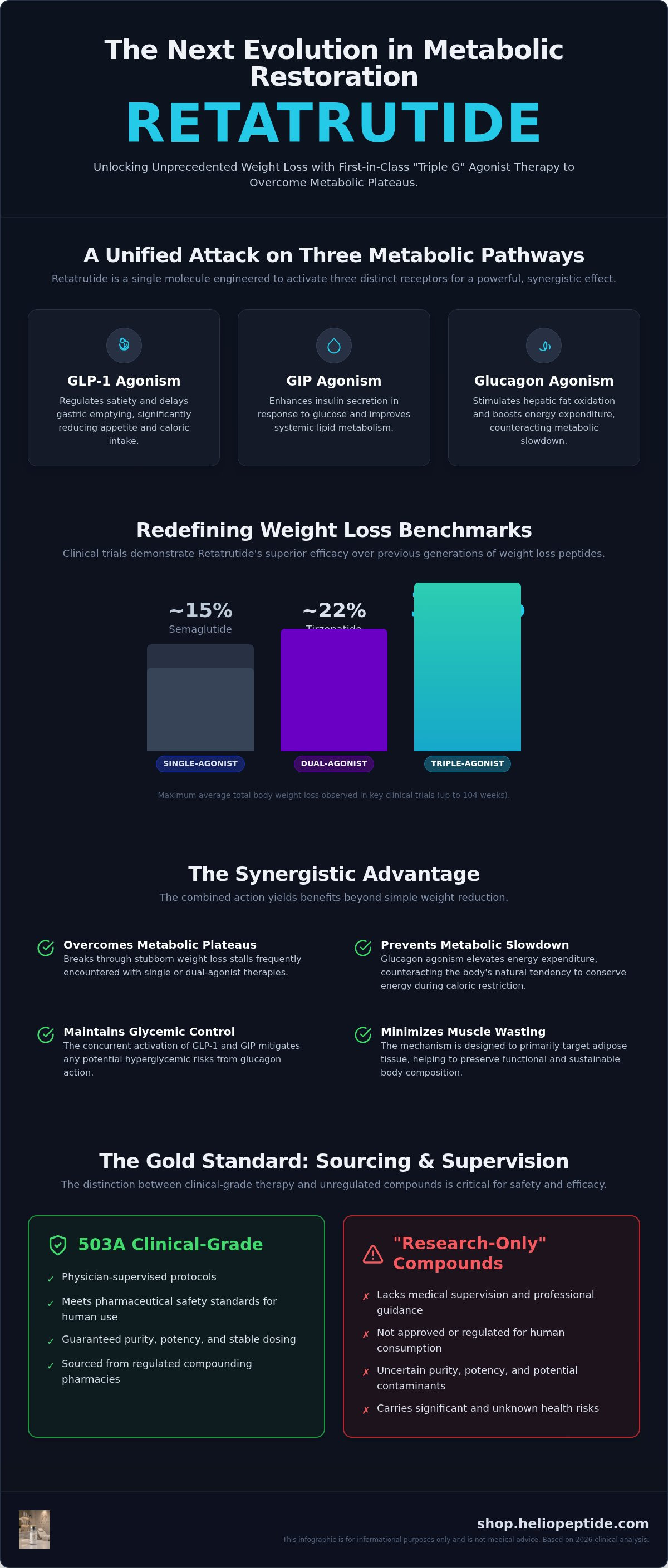
Retatrutide represents a sophisticated departure from first and second-generation peptide therapies. It is engineered as a unimolecular peptide that targets three distinct metabolic pathways through a single molecular structure. By acting as a high-affinity agonist for the Glucagon-Like Peptide-1 (GLP-1), Glucose-Dependent Insulinotropic Polypeptide (GIP), and glucagon receptors, the Retatrutide triple-agonist mechanism coordinates a systemic metabolic response that single-receptor agonists cannot replicate. In a clinical environment, retatrutide 10mg is deployed to bypass the physiological plateaus frequently encountered with simpler dual-agonist protocols. The GLP-1 component functions primarily within the central nervous system to regulate satiety and delay gastric emptying, while the GIP component enhances insulin secretion and improves systemic lipid metabolism.
The Role of Glucagon in Metabolic Optimization
Traditional weight loss interventions often trigger a compensatory reduction in basal metabolic rate, a biological state where the body attempts to conserve energy in response to perceived scarcity. Glucagon receptor agonism directly counteracts this defense mechanism by stimulating hepatic fat oxidation and promoting thermogenesis. This shift in cellular signaling effectively elevates energy expenditure even during periods of caloric restriction, preventing the metabolic slowdown associated with standard dieting. Clinical observations from late-stage trials have also demonstrated a profound impact on non-alcoholic fatty liver disease (NAFLD). By accelerating the clearance of intrahepatic lipids, the peptide facilitates a restoration of liver function that exceeds the results seen with earlier incretin-based therapies.
Synergistic Agonism: Why Three Receptors Are Better Than Two
The integration of three distinct receptors represents the definitive frontier in metabolic medicine. While glucagon agonism alone might theoretically elevate blood glucose levels, the concurrent activation of the GIP and GLP-1 receptors maintains tight glycemic control and mitigates potential hyperglycemic risks. This balanced synergy allows for a more robust metabolic profile that remains within a safe clinical window. The primary objective of a retatrutide 10mg protocol is the optimization of body composition through triple-agonist signaling. By increasing the metabolic furnace via glucagon while simultaneously suppressing appetite via the incretin pathways, the therapy aims to achieve maximal adipose tissue loss. This approach is designed to minimize the muscle wasting often observed in rapid weight loss scenarios, ensuring that the physical optimization is both functional and sustainable.
Clinical Efficacy: Analyzing Retatrutide Results and Trials
The clinical data emerging in 2026 confirms that retatrutide functions as a dose-dependent agent with a distinct efficacy ceiling. At the retatrutide 10mg threshold, patients observe a profound metabolic shift that differentiates this triple-agonist from its predecessors. While earlier therapies often lead to a plateau in weight reduction, current clinical observations indicate that retatrutide maintains a downward trajectory in adipose tissue for extended durations. This sustained efficacy is attributed to the synergistic activation of the glucagon receptor alongside the incretin pathways, which prevents the metabolic adaptation typically seen during caloric restriction.
The 28% Weight Loss Benchmark
Retatrutide has fundamentally reset expectations for medical weight management. In the TRIUMPH-1 trial, participants achieved a mean weight reduction of 28.3% at 80 weeks, with that figure climbing to 30.3% by week 104. These results significantly outperform the 15% to 22% ranges typically associated with semaglutide and tirzepatide protocols. In clinical circles, it's often termed the "King of GLP-1s" because it addresses the metabolic resistance that dual-agonists sometimes fail to penetrate. Clinical data at the 48-week mark indicates that retatrutide facilitates a weight reduction profile that significantly exceeds the historical benchmarks set by single and dual-agonist therapies.
Metabolic Health Beyond the Scale
The clinical utility of this peptide extends far beyond simple weight reduction. Data from the Retatrutide Phase 3 TRIUMPH-3 trial highlights significant improvements in systolic and diastolic blood pressure, as well as favorable shifts in lipid profiles. For diabetic and pre-diabetic patients, the impact on HbA1c levels is particularly noteworthy, with many participants achieving glycemic normalization. Fasting insulin levels and overall glucose sensitivity show marked improvement, suggesting a restorative effect on the endocrine system. Key metabolic markers observed in clinical settings include:
- Normalization of HbA1c levels in type 2 diabetic populations.
- Reductions in liver fat content exceeding 80% in specific cohorts.
- Significant improvements in fasting glucose and insulin sensitivity.
- Reduction in systemic inflammation markers associated with cardiovascular risk.
As of July 2026, the medical community is closely monitoring ongoing cardiovascular outcomes trials. These studies are designed to quantify long-term protection against major adverse cardiovascular events (MACE). Early signals suggest that the reduction in visceral fat and the improvement in lipid markers contribute to a substantial decrease in cardiovascular risk factors. For patients with obesity-related knee osteoarthritis, the TRIUMPH-4 trial demonstrated a 28.7% mean weight loss at 68 weeks, proving that the benefits of retatrutide 10mg are multifaceted. To ensure these outcomes are achieved through high-purity compounds, it's essential to utilize a physician-led peptide program that prioritizes clinical safety.
Retatrutide vs. Tirzepatide and Semaglutide: A Comparative Analysis
The evolution of incretin mimetics has progressed from single-receptor activation to the sophisticated triple-agonist signaling of retatrutide 10mg. Semaglutide, a selective GLP-1 agonist, established the clinical baseline by focusing on appetite suppression and delayed gastric emptying. Tirzepatide advanced this protocol by integrating GIP agonism, which enhances lipid metabolism and insulin sensitivity. Retatrutide represents the third generation, introducing glucagon receptor activation to elevate basal energy expenditure. While the "side effect to weight loss" ratio remains favorable across all three generations, the triple-agonist profile offers a more aggressive metabolic intervention for patients who have reached a physiological plateau on dual-agonist therapies.
The clinical distinction between these peptides is defined by their receptor affinity and the resulting physiological response. Semaglutide is primarily an appetite regulator. Tirzepatide acts as a metabolic stabilizer. Retatrutide functions as a metabolic accelerator. For patients with high degrees of metabolic resistance, the shift from a dual to a triple agonist can be the difference between a stalled weight loss journey and continued progress toward body composition goals.
Choosing Your GLP-1 Protocol
A patient's transition between peptide classes is a clinical decision that should be dictated by metabolic response rather than arbitrary timelines. Many individuals successfully begin their journey with a Semaglutide 15 mg Lyophilized protocol to establish tolerance and achieve initial adipose reduction. However, when metabolic adaptation occurs, the body often enters a defensive state of reduced thermogenesis. This is the precise clinical indication for moving toward retatrutide 10mg. The addition of the glucagon component bypasses this adaptation by forcing the body to maintain higher rates of fat oxidation, even when caloric intake is reduced. These transitions must always be physician-led to ensure that titration schedules are adjusted for the increased potency of triple-agonist therapy.
The Triple Agonist Advantage
The primary advantage of triple-agonism lies in the balance between appetite suppression and active energy expenditure. While GLP-1 and GIP predominantly manage the "input" side of the metabolic equation, the glucagon receptor addresses the "output." This dual-action approach ensures that weight loss isn't solely a result of caloric deficit but also a consequence of an optimized metabolic rate. Clinical stability is also a critical factor; the lyophilized format of retatrutide ensures maximum molecular integrity and bioavailability compared to standard liquid preparations. For a detailed breakdown of these technological advancements, refer to our analysis on Retatrutide 10mg: The Triple-Agonist Evolution. This framework allows physicians to tailor protocols to the specific degree of metabolic resistance presented by the patient, ensuring that the therapy remains both safe and effective over long-term durations.
The 503A Pharmacy Standard: Ensuring Sourcing Purity and Safety
The distinction between "Research Grade" and "Clinical Grade" peptides is not merely a labeling convention; it is a fundamental difference in manufacturing oversight and biological safety. Research-grade compounds are intended strictly for laboratory use and lack the mandatory sterility and potency testing required for human administration. In contrast, 503A pharmacies operate under stringent state and federal regulations, providing patient-specific medications that meet high pharmaceutical standards. When sourcing retatrutide 10mg, the use of non-regulated "research" vials introduces significant health risks. These substances are often manufactured in facilities that don't adhere to Current Good Manufacturing Practices (cGMP), leading to potential contamination with heavy metals, endotoxins, or residual solvents that can cause systemic inflammatory responses or long-term organ toxicity.
Rigorous testing protocols in a 503A environment involve High-Performance Liquid Chromatography (HPLC) and Mass Spectrometry to verify that every batch matches its stated chemical profile. This level of precision ensures that the potency is exact, preventing the erratic dosing that occurs with cheaper, non-verified alternatives. Essential testing standards in clinical pharmacies include:
- Purity verification via HPLC to ensure molecular consistency.
- Sterility testing to guarantee zero microbial contamination.
- Potency analysis to confirm the exact milligram concentration.
- Endotoxin screening to prevent dangerous pyrogenic reactions.
Why Physician Supervision is Non-Negotiable
Triple-agonist therapy requires a level of clinical oversight that generic weight loss programs cannot provide. Because the peptide activates the glucagon receptor, physicians must monitor specific physiological markers, including heart rate and gallbladder function, which can be affected by rapid metabolic shifts. A best online semaglutide program provides the framework for this supervision, ensuring that dosing titration is managed according to individual tolerance and metabolic response. Without professional guidance, the risk of improper reconstitution or inaccurate self-dosing increases significantly, potentially leading to severe gastrointestinal distress or cardiovascular stress.
The Benefits of Lyophilized Peptides
Lyophilization, or freeze-drying, is the clinical standard for preserving the structural integrity of complex peptide chains. This process involves removing moisture under a vacuum at extremely low temperatures, which stabilizes the molecule and prevents degradation. Lyophilized retatrutide 10mg offers superior shelf-life and temperature stability compared to liquid preparations, which are prone to rapid molecular breakdown and loss of efficacy. Reconstitution should only occur immediately prior to the start of a treatment cycle using sterile bacteriostatic water. This method ensures the solution remains free of microbial growth and maintains the precise bioavailability required for optimal metabolic results.
To ensure your protocol meets these clinical standards, you can access our physician-supervised peptide therapy programs.
Starting a Physician-Supervised Retatrutide 10mg Program
Initiating an advanced metabolic protocol requires a structured clinical framework to ensure safety and efficacy. Helio Peptide facilitates this through a comprehensive telehealth model that connects patients with licensed physicians specializing in metabolic optimization. Unlike the unregulated "research-only" market, our process begins with a rigorous medical screening to determine if retatrutide 10mg is the appropriate therapeutic target for your specific physiological profile. Once a prescription is issued, the medication is prepared by an FDA-regulated 503A pharmacy and delivered directly to your residence in a stabilized, lyophilized format. This end-to-end clinical oversight is a core component of a physician-supervised HRT or peptide program, providing the necessary safeguards for high-potency triple-agonist therapy.
The Telehealth Consultation Process
The journey starts with a detailed review of your medical history and current metabolic status. During the initial consultation, physicians evaluate your specific health objectives, whether they involve overcoming a weight loss plateau or improving systemic insulin sensitivity. Comprehensive blood work is a mandatory prerequisite for optimizing therapy. These diagnostic markers allow the medical team to establish a baseline for hepatic function, cardiovascular health, and endocrine balance. By analyzing these variables, our clinicians can tailor the protocol to your unique biology. This data-driven approach ensures that the introduction of advanced peptides is precise and transparent, reflecting our commitment to pharmaceutical-grade standards over anecdotal experimentation.
Personalized Wellness and Titration
While retatrutide 10mg is often the clinical target for maximal metabolic impact, it's rarely the initial dose. A "start low, go slow" titration schedule is strictly followed to allow the body to adapt to the triple-agonist mechanism. This methodical progression is essential for minimizing gastrointestinal side effects and ensuring long-term adherence to the protocol. Your physician will provide ongoing support, adjusting dosages based on your metabolic response and tolerance levels. The delivery process is equally rigorous; each vial is shipped in specialized packaging to maintain the integrity of the lyophilized peptide chain until it reaches your door. This personalized titration and secure logistics chain ensures that the therapy remains effective while prioritizing your physiological well-being. For those ready to begin their transition toward advanced metabolic restoration, explore our comprehensive guide on peptide therapy for weight loss.
Advancing Toward Metabolic Restoration
Retatrutide represents the current peak of peptide therapy, utilizing a triple-agonist pathway to achieve results that were previously unattainable with single or dual-receptor agents. By integrating glucagon signaling with traditional incretin pathways, this molecule effectively bypasses metabolic adaptation and provides a robust solution for those stalled on earlier protocols. Sourcing retatrutide 10mg through legitimate clinical channels remains the only pathway to ensure molecular purity and systemic safety in a landscape often crowded with unregulated alternatives.
Accessing these advanced solutions requires a foundation of professional guidance and strict regulatory compliance. Our programs utilize clinical-grade lyophilized peptides sourced exclusively from FDA-regulated 503A pharmacies to guarantee the highest standards of stability and potency. Every treatment plan is supported by physician-led clinical oversight to ensure that your titration and monitoring protocols are executed with medical precision. Begin your physician-supervised Retatrutide program with Helio Peptide to secure a future defined by biological optimization and sustained metabolic health. Your journey toward peak physiological performance is supported by the most advanced science available today.
Frequently Asked Questions
What is the recommended dosage for Retatrutide 10mg?
Clinical protocols typically begin with a low-dose titration, such as 2mg or 4mg weekly, to establish gastrointestinal tolerance. The 10mg dosage is often considered a maintenance threshold achieved after several months of incremental escalation. Physician oversight is required to adjust this schedule based on individual metabolic markers and symptomatic response.
How does Retatrutide differ from Tirzepatide (Zepbound)?
Retatrutide is a triple-agonist targeting GLP-1, GIP, and glucagon receptors, whereas tirzepatide is a dual-agonist targeting only GLP-1 and GIP. The inclusion of the glucagon receptor in a retatrutide 10mg protocol stimulates thermogenesis and increases energy expenditure, offering a more aggressive metabolic intervention than dual-agonist therapies.
Are there specific side effects associated with the triple-agonist mechanism?
Primary side effects include nausea, diarrhea, and constipation, which are consistent with other incretin mimetics. However, the glucagon component may lead to a transient increase in heart rate or specific effects on gallbladder health. These physiological shifts necessitate regular monitoring of cardiovascular and hepatic markers during the treatment cycle.
Can I use Retatrutide 10mg if I have already plateaued on Semaglutide?
Patients who've reached a weight loss plateau on semaglutide often find success with retatrutide because it introduces new metabolic pathways. By activating three distinct receptors, the peptide bypasses the body's compensatory mechanisms that slow down weight loss on single-agonist protocols. It's specifically designed for cases of high metabolic resistance.
How do I reconstitute Retatrutide 10mg lyophilized powder safely?
Reconstitution of retatrutide 10mg requires the introduction of sterile bacteriostatic water into the lyophilized vial using an aseptic technique. The water should be allowed to run down the side of the glass to avoid damaging the delicate peptide chains. You shouldn't shake the vial; instead, gently swirl it until the powder is completely dissolved and the solution is clear.
Is Retatrutide 10mg available for human use through a physician?
While still under clinical investigation for broad commercial release in 2026, retatrutide is accessible through specialized physician-supervised programs that utilize 503A compounding pharmacies. These programs provide a legal and regulated framework for patients to access advanced peptide therapy under strict medical guidance and oversight.
What is a 503A pharmacy, and why does it matter for peptide sourcing?
A 503A pharmacy is a state-licensed facility that compounds medications for specific patients based on a physician's prescription. These pharmacies are essential for peptide sourcing because they adhere to high standards of sterility and potency testing. This ensures that the medication is clinical-grade and free from the contaminants often found in unregulated research compounds.
How fast can I expect results with a Retatrutide protocol?
Initial metabolic shifts, including appetite suppression and improved glycemic control, are often observable within the first four weeks of therapy. Significant adipose tissue reduction typically becomes measurable by week eight. Clinical data suggests that the most profound results occur between 48 and 80 weeks of consistent adherence to the prescribed protocol.
