Microdosing GLP-1: A Clinical Analysis of Precision Titration and Metabolic Response
The highest dose isn't always the most effective dose. For a growing number of patients pursuing GLP-1 receptor agonist therapy, the standard escalation protocol, designed to push toward peak dosing thresholds, has produced outcomes that undermine the treatment itself: persistent nausea, accelerated lean muscle loss, and a cost burden that makes long-term adherence impractical. The clinical case for choosing to microdose GLP-1 agonists is built not on compromise, but on precision.
If you've experienced debilitating gastrointestinal side effects on a conventional titration schedule, or if you're concerned about preserving muscle mass while managing your weight, your instinct to question the standard approach is clinically well-founded. Receptor saturation and metabolic response are not linear, and the assumption that more medication produces proportionally better outcomes doesn't hold for every patient's physiology.
This analysis examines the pharmacological rationale behind precision titration of GLP-1 therapies, the metabolic mechanisms that make lower-dose protocols viable, and how physician-supervised individualization can deliver sustained appetite regulation and improved insulin sensitivity without the adverse effects that force so many patients to discontinue treatment altogether.
Key Takeaways
- The decision to microdose GLP-1 agonists is grounded in receptor pharmacology, not compromise — lower fractional doses can achieve meaningful appetite regulation and insulin sensitization while significantly reducing the adverse effects that drive discontinuation.
- Standard manufacturer titration schedules are designed for population-level outcomes, not individual metabolic profiles; personalized entry points and precision titration offer a clinically defensible alternative for patients who cannot tolerate conventional escalation protocols.
- Controlled, lower-dose GLP-1 protocols may mitigate accelerated lean muscle loss and preserve body composition outcomes that high-dose rapid titration can undermine — a distinction with significant long-term metabolic consequences.
- Sourcing matters as much as dosing: clinical-grade lyophilized peptides prepared under 503A pharmacy standards are a prerequisite for the measurement precision that safe microdose glp-1 protocols require.
- Physician-supervised individualization — integrating titration design, metabolic monitoring, and appropriate peptide selection — is the determinative factor separating effective precision protocols from unsupervised experimentation.
Defining GLP-1 Microdosing in a Clinical Context
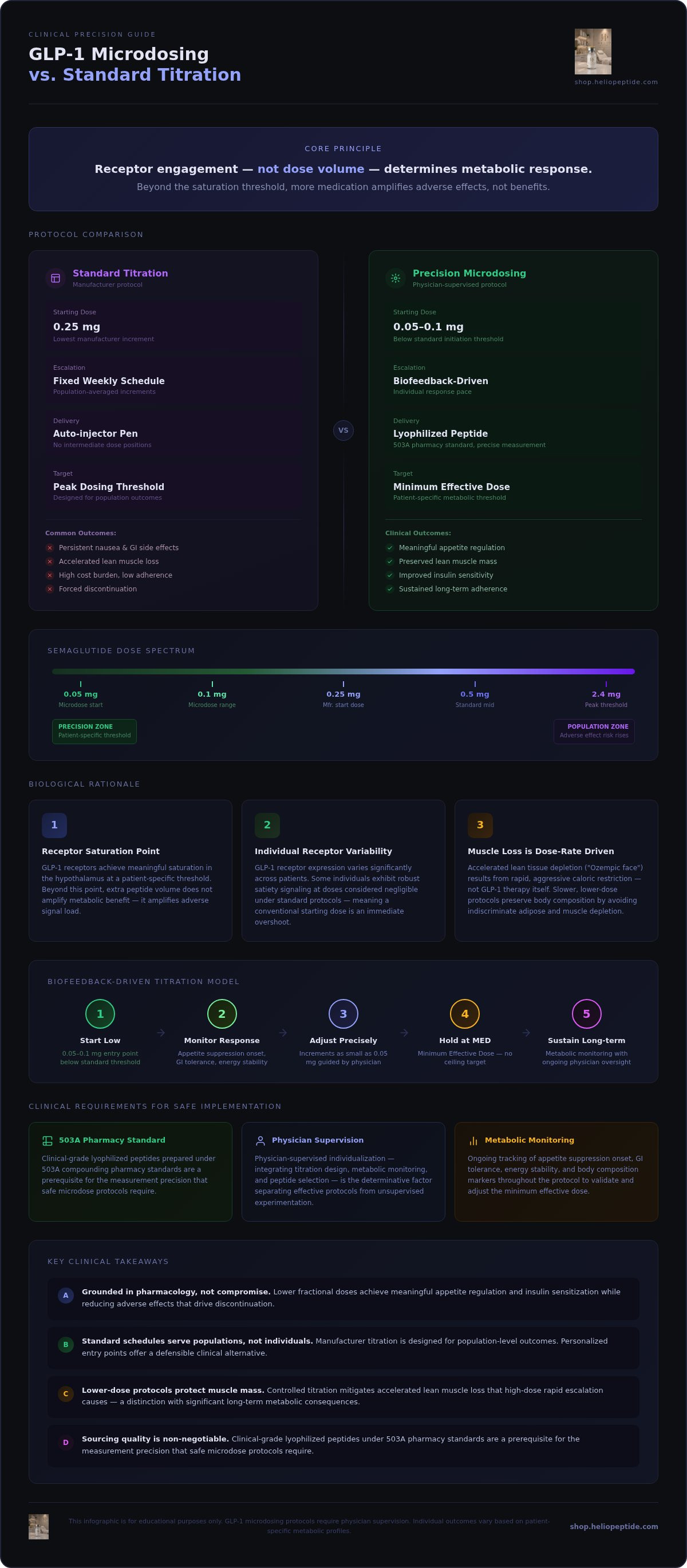
In clinical terms, microdose GLP-1 therapy refers to the administration of GLP-1 receptor agonists at fractional doses that fall below the conventional therapeutic thresholds established in manufacturer titration protocols. This is not a loosely defined patient preference or a workaround born of inconvenience. It is a pharmacologically grounded approach that acknowledges a fundamental reality: receptor engagement, not dose volume, determines metabolic response.
Standard GLP-1 formulations are delivered through fixed-dose auto-injector pens calibrated for population-averaged outcomes. A patient either receives the designated increment or they don't. There is no intermediate position within that delivery system. The transition to precision milligram titration, made possible through lyophilized peptide formulations reconstituted for individualized dosing, removes that constraint entirely and allows clinicians to position a patient's dose with a specificity that fixed-dose devices cannot achieve.
The Shift from Fixed Dosing to Precision Titration
Manufacturer escalation schedules are engineered around efficacy benchmarks observed across large clinical trial populations. They are not designed with individual receptor sensitivity as the primary variable. The biological variability in GLP-1 receptor expression across different patient populations is well-documented in endocrinology literature; some individuals exhibit robust satiety signaling at doses that would be considered negligible under a standard protocol. For these patients, a conventional starting dose isn't a gentle introduction to therapy. It's an immediate overshoot. Precision titration addresses this by treating the dose-response curve as patient-specific rather than population-derived.
Identifying the Microdose Threshold
A true microdose is distinct from a standard starting dose. A conventional semaglutide initiation dose of 0.25mg is already the lowest increment on a manufacturer's schedule; a genuine microdose protocol may begin at 0.1mg or lower, with incremental upward adjustments guided entirely by patient biofeedback, including appetite suppression onset, gastrointestinal tolerance, and energy stability. The objective is to identify the minimum effective dose for that individual's metabolic threshold, not to advance toward a ceiling.
Understood in its most precise clinical framing, microdosing GLP-1 agonists is a method of metabolic recalibration: a deliberate, supervised process of locating the dose at which meaningful physiological response occurs without the receptor overstimulation that produces adverse effects and compromises long-term adherence.
- Fractional dosing: Doses positioned below standard initiation thresholds, calibrated in increments as small as 0.05mg to 0.1mg
- Biofeedback-driven adjustment: Titration pace determined by individual response, not a fixed weekly schedule
- Precision delivery prerequisite: Lyophilized peptide formulations prepared under 503A pharmacy standards are required to achieve this level of measurement accuracy
The Biological Rationale for Lower-Dose GLP-1 Protocols
Receptor engagement is dose-dependent only up to a point. Beyond the threshold at which GLP-1 receptors achieve meaningful saturation in the hypothalamus and gastrointestinal tract, additional peptide volume doesn't amplify metabolic benefit; it amplifies adverse signal load. Understanding where that threshold sits for an individual patient is the central biological question that lower-dose protocols are designed to answer.
The phenomenon colloquially termed "Ozempic face," characterized by accelerated facial volume loss and a gaunt appearance, is not an inevitable consequence of GLP-1 therapy. It's a consequence of rapid, high-dose weight reduction that depletes both adipose and lean tissue indiscriminately. When caloric restriction is too aggressive, the body draws on skeletal muscle as a metabolic substrate. The rate of weight loss, not the therapy itself, is the primary driver of this outcome. Controlled, lower-dose protocols slow the rate of fat oxidation deliberately, allowing adipose tissue to be preferentially mobilized while lean mass is preserved through maintained anabolic signaling.
Mitigating Gastrointestinal Adverse Effects
GLP-1-induced nausea originates from two distinct anatomical pathways: central chemoreceptor trigger zone activation in the area postrema, and peripheral deceleration of gastric emptying. At standard initiation doses, both signals fire simultaneously. Micro-titration decouples these responses by allowing central receptor tolerance to develop incrementally before peripheral gastric motility is significantly altered. The result is a gradual accommodation to peptide-induced satiety signaling rather than an abrupt systemic disruption. Constipation and dyspepsia, which arise primarily from delayed gastric emptying, are substantially attenuated when dose escalation is paced to the patient's gastrointestinal adaptation rate rather than a fixed weekly schedule.
Preserving Metabolic Flexibility
High-dose GLP-1 protocols carry an underappreciated risk: suppressing appetite so completely that caloric intake falls below the threshold required to sustain basal metabolic rate. The body's adaptive response to prolonged severe caloric deficit includes downregulation of thyroid hormone conversion, reduced resting energy expenditure, and accelerated muscle catabolism. A well-calibrated microdose glp 1 protocol maintains appetite modulation within a range that supports fat oxidation without triggering these compensatory metabolic slowdowns. Insulin sensitization, one of GLP-1's most clinically valuable effects, operates independently of appetite suppression and is preserved at lower doses.
For patients focused on body composition outcomes, the strategic combination of precision GLP-1 titration with complementary peptide therapies warrants clinical consideration. A review of the best peptides for muscle growth and fat loss identifies several agents that support anabolic signaling during periods of caloric restriction, providing a mechanistic counterbalance to the catabolic pressure that weight loss inherently creates.
- Gastric emptying rate: Lower doses produce proportionally less motility deceleration, reducing dyspepsia and constipation risk without eliminating satiety signaling
- Lean mass preservation: Slower, controlled fat oxidation reduces reliance on skeletal muscle as a caloric substrate during weight reduction
- Glucose homeostasis: Insulin sensitization is maintained at sub-maximal doses, delivering metabolic benefit without total appetite suppression
If preserving body composition while achieving meaningful fat loss is a clinical priority, physician-supervised microdose glp 1 protocols combined with targeted peptide support represent a structurally sound approach worth discussing with a qualified prescriber. Explore advanced peptide therapy options designed for precisely this kind of individualized metabolic management.
Microdosing vs. Standard Manufacturer Titration Schedules
Standard titration schedules were built for clinical trial populations, not individual patients. Understanding the structural gap between those two contexts is essential for any clinician or patient evaluating whether a precision microdose glp 1 protocol represents a clinically superior alternative to manufacturer-defined escalation.
Evaluating the STEP Trial Protocols
The STEP trials, which established the regulatory foundation for semaglutide's approval in chronic weight management, used a structured escalation from 0.25mg weekly to a 2.4mg maintenance dose over approximately twenty weeks. The trials demonstrated statistically significant weight reduction at this ceiling dose, but a detail frequently omitted from clinical summaries is that meaningful weight loss was documented at considerably lower maintenance doses in subgroup analyses. The 2.4mg target was selected to maximize average outcomes across a heterogeneous population, not to identify the minimum effective dose for a given metabolic profile.
The clinical trade-off embedded in this design is significant. Faster weight loss, achieved through aggressive escalation, correlates with higher rates of gastrointestinal adverse events and protocol discontinuation. Real-world adherence data consistently diverges from trial completion rates, and the patients who discontinue are disproportionately those who experienced the most aggressive early side effect profiles. Speed of weight loss is not synonymous with sustainability of the protocol.
Personalization for Hyper-Responders
A clinically distinct patient subgroup exists that doesn't fit the standard escalation model: the hyper-responder. These individuals exhibit robust satiety signaling, measurable appetite suppression, and progressive weight reduction at doses that most titration schedules would classify as a transient starting point rather than a therapeutic destination. Advancing these patients up the standard escalation ladder doesn't improve outcomes; it introduces risk without proportional benefit.
The clinical indicators of hyper-response include:
- Significant appetite suppression within 48 to 72 hours of a low initiating dose
- Symptomatic fatigue or lightheadedness disproportionate to the dose administered
- Blood glucose readings trending toward hypoglycemic thresholds without concurrent antidiabetic medications
- Rapid early weight reduction exceeding expected rate for the dose level
For hyper-responders, the most clinically sound decision is to hold at the effective low dose rather than continue escalation. Some patients in physician-supervised programs remain on sub-0.5mg weekly doses for the full duration of their protocol, achieving and maintaining their target body composition without ever approaching standard maintenance thresholds. This isn't a treatment shortfall; it's a precision outcome. Long-term maintenance after reaching goal weight is also where microdose glp 1 protocols demonstrate particular structural advantage: the lowest dose that sustains metabolic equilibrium is the dose with the most favorable long-term tolerability profile, and that dose is almost always below what standard schedules define as therapeutic.
Clinical Requirements for Safe Implementation and Sourcing
Precision titration is only as reliable as the compound being titrated. A microdose glp 1 protocol built on a foundation of inconsistent peptide purity or unstable formulation chemistry cannot deliver the dose accuracy that individualized metabolic management requires. The sourcing decision isn't a secondary consideration; it's a prerequisite that determines whether the clinical rationale for lower-dose protocols can actually be executed in practice.
The Advantage of Lyophilized Peptides
Lyophilized, or freeze-dried, peptide formulations offer a structural advantage that liquid preparations cannot match for non-standard dosing schedules. The lyophilization process removes water from the peptide matrix under controlled vacuum conditions, halting the molecular degradation that occurs continuously in aqueous solution. The result is a stable, powder-form compound with a substantially extended shelf life and a purity profile that remains intact until the moment of reconstitution.
Reconstitution with bacteriostatic water immediately before administration allows the clinician or patient to prepare a precise concentration, enabling milligram-level dose calibration that fixed-dose delivery systems are structurally incapable of providing. Liquid peptide formulations, by contrast, begin degrading upon preparation and are subject to concentration drift over time, meaning the dose delivered on day fourteen of a vial's use may differ meaningfully from the dose delivered on day one. For a protocol where a 0.05mg variance can determine whether a patient experiences adverse effects or therapeutic benefit, that instability is clinically unacceptable.
Navigating Regulatory Standards
Not all compounded peptides are equivalent under United States pharmacy law, and the distinction between 503A and 503B oversight carries direct implications for patient safety. Section 503A pharmacies compound medications for individual patients under a valid prescription from a licensed practitioner, operating under state board of pharmacy oversight with USP standards governing sterility and potency. Section 503B outsourcing facilities operate under direct FDA oversight and produce larger batch quantities for healthcare facilities. For individualized microdose glp 1 protocols, 503A-compliant compounding pharmacies represent the appropriate regulatory framework, provided they are operating under a legitimate prescriber-patient relationship.
Third-party Certificates of Analysis, issued by independent laboratories, are a non-negotiable verification standard. A COA confirms peptide identity, purity percentage, and the absence of contaminants including endotoxins and residual solvents. Any peptide source that cannot produce a current, third-party COA on request should be disqualified immediately from clinical consideration.
The "research chemical" market occupies a categorically different space. Compounds sold under that designation are not subject to pharmacy compounding standards, are not dispensed under prescriber oversight, and carry no enforceable purity guarantees. The risks introduced by unknown concentration and contamination are incompatible with any legitimate clinical protocol. As detailed in the clinical reference on advanced peptide therapy, rigorous sourcing is the structural foundation on which all other therapeutic decisions rest.
- 503A pharmacy compliance: Confirms individual patient compounding under licensed prescriber oversight and applicable USP sterility standards
- Third-party COA verification: Independent confirmation of peptide identity, purity, and contaminant absence before clinical use
- Lyophilized formulation: Stability and concentration integrity preserved until point-of-use reconstitution, enabling the measurement precision that precision titration demands
Physician-supervised programs that integrate compliant sourcing with individualized titration design represent the only defensible implementation pathway. Review clinical-grade peptide therapy options prepared to the pharmacy standards that precision protocols require.
The Helio Peptide Protocol: Physician-Supervised Optimization
General health coaching isn't a substitute for physician-led metabolic management. The distinction matters most precisely where GLP-1 therapy is most complex: at the intersection of individual receptor sensitivity, body composition goals, and long-term adherence. Helio Peptide's approach is built on board-certified physician oversight from the first consultation, with titration plans designed around the patient's specific metabolic profile rather than a generalized escalation template.
Protocol design begins with peptide selection. For patients whose clinical profile supports a more aggressive metabolic intervention, Retatrutide 10mg introduces triple agonist activity across GLP-1, GIP, and glucagon receptors simultaneously, producing a broader metabolic signal than semaglutide alone. The choice between these agents isn't arbitrary; it's determined by baseline glycemic status, cardiovascular risk factors, and the patient's specific body composition objectives. Microdose glp 1 protocols using semaglutide remain the appropriate framework for many patients, particularly those with documented gastrointestinal sensitivity or a history of intolerance to faster-escalating regimens.
Telehealth integration removes the logistical barriers that historically forced patients into infrequent, episodic clinical contact. Continuous access to supervising physicians allows titration adjustments to be made in response to real-time biofeedback rather than waiting for a scheduled quarterly appointment. That responsiveness is clinically meaningful: a patient experiencing early satiety overshoot at week two doesn't need to wait six weeks to have their dose corrected.
Comprehensive Metabolic Monitoring
Baseline bloodwork establishes the reference architecture for every subsequent clinical decision. Fasting glucose, HbA1c, lipid panels, inflammatory markers including high-sensitivity CRP, and thyroid function are assessed before initiation and at defined intervals throughout the protocol. Adjustments to titration pace are driven by these objective data points, not by symptom reporting alone. Tracking inflammatory markers alongside glycemic control identifies patients whose metabolic adaptation is trending toward the compensatory slowdown that unsupervised protocols frequently miss entirely.
The Path to Sustainable Wellness
Weight on a scale is an incomplete outcome metric. Sustained improvement in body composition, specifically the ratio of lean mass to adipose tissue, and measurable gains in energy stability and cognitive clarity are the clinical benchmarks that define long-term success. Used correctly, a precision microdose glp 1 protocol functions as a behavioral recalibration tool: appetite normalization at sub-maximal doses creates the physiological conditions under which healthier dietary patterns become sustainable without volitional effort fighting against hunger signaling.
The transition from active weight reduction to long-term healthspan optimization is managed as a distinct protocol phase, not an afterthought. Helio Peptide ensures every microdose protocol is backed by 503A pharmacy-compliant sourcing, providing the compound integrity and concentration reliability that individualized metabolic management demands from the first dose to the last. Explore physician-supervised peptide therapy options designed for precisely this level of clinical precision.
Precision Over Protocol: The Case for Individualized GLP-1 Therapy
Standard escalation schedules were built for populations. Your metabolism isn't a population average. The clinical case for microdose glp 1 therapy rests on three well-established realities: receptor engagement determines metabolic response, not dose volume; gastrointestinal tolerance and lean mass preservation both improve when titration pace matches individual physiology; and long-term adherence requires a protocol designed around your threshold, not a manufacturer's ceiling.
Executing this approach safely requires more than a lower dose. It requires clinical-grade peptides sourced from 503A-compliant pharmacies, board-certified physician oversight at every stage of titration, and access to a supervising clinician who can respond to real-time biofeedback rather than quarterly appointment windows. Helio Peptide provides all three through nationally available telehealth, removing the logistical barriers that historically kept precision protocols out of reach.
The path to sustained metabolic improvement starts with a physician-designed protocol built around your biology. Begin your physician-supervised GLP-1 program with Helio Peptide today and take the first step toward therapy that's calibrated to work with your physiology, not against it.
Frequently Asked Questions About Microdose GLP-1 Therapy
What exactly is considered a microdose of a GLP-1 medication?
A microdose GLP-1 protocol positions the administered dose below the lowest increment on a manufacturer's standard titration schedule. For semaglutide, this means initiating at 0.1mg or lower, compared to the conventional 0.25mg starting point, with upward adjustments measured in increments as small as 0.05mg. The defining characteristic isn't a fixed number; it's the clinical intent to identify the minimum dose at which meaningful appetite modulation and insulin sensitization occur for that specific patient's receptor sensitivity.
Can I still lose weight if I am taking a dose lower than what is recommended?
Yes. Subgroup analyses from major clinical trials documented meaningful weight reduction at maintenance doses considerably below the approved ceiling thresholds. GLP-1 receptor engagement produces metabolic response at fractional doses; the relationship between dose volume and clinical outcome isn't linear for every patient. Hyper-responders, in particular, achieve progressive fat loss and sustained appetite regulation at doses that standard protocols classify as a transient starting point, never advancing further up the escalation ladder.
Is microdosing GLP-1s safer than standard dosing schedules?
Lower-dose protocols reduce the primary mechanisms behind the most common adverse effects. Nausea arises from simultaneous activation of central chemoreceptor pathways and peripheral gastric motility deceleration; fractional dosing allows central receptor accommodation to develop before gastric emptying is significantly affected. That said, "safer" is a patient-specific determination. A physician-supervised microdose GLP-1 protocol with appropriate metabolic monitoring is demonstrably safer than unsupervised self-titration at any dose level. Oversight is the safety variable, not dose alone.
How do I talk to a doctor about trying a microdose protocol?
Frame the conversation around documented clinical priorities: a history of GI intolerance on standard escalation schedules, a specific goal of lean mass preservation during weight reduction, or a desire to identify your minimum effective dose before advancing further. Bring objective context where possible, including any prior adverse event timeline. Physicians supervising individualized metabolic programs are increasingly familiar with precision titration frameworks; the conversation is most productive when it's grounded in your specific clinical history rather than a general preference for lower doses.
Are there specific side effects associated with taking very low doses?
At genuinely fractional doses, the gastrointestinal adverse effects that characterize standard initiation are substantially attenuated. The more clinically relevant consideration at very low doses is under-response: insufficient appetite modulation or no measurable change in satiety signaling, which indicates the dose hasn't yet reached the individual's receptor engagement threshold. Fatigue and mild lightheadedness can occur in hyper-responders even at sub-standard doses, which is itself a clinical signal to hold rather than escalate. Physician monitoring distinguishes therapeutic response from adverse response at these dose levels.
How do I accurately measure a microdose using lyophilized peptides?
Lyophilized peptides are reconstituted with bacteriostatic water to a clinician-specified concentration, typically expressed in milligrams per milliliter. Once reconstituted, an insulin syringe calibrated in 0.01mL increments allows sub-milligram dose precision that fixed-dose auto-injectors structurally can't achieve. The specific reconstitution volume and resulting concentration should be calculated and confirmed by the supervising physician before administration. Liquid peptide formulations aren't suitable for this purpose because concentration stability degrades over the vial's use period, introducing measurement variability that's clinically unacceptable at fractional doses.
Can I microdose if I have already been on a high dose for several months?
Transitioning from a high-dose protocol to a precision low-dose maintenance approach is clinically viable, but it requires structured physician oversight rather than self-directed reduction. Abrupt dose reduction after extended high-dose exposure can trigger appetite rebound, and the appropriate step-down pace depends on your current metabolic status, body composition trajectory, and baseline bloodwork. A supervising physician will assess whether your current dose is producing diminishing returns relative to its adverse effect profile before designing a downward titration schedule.
Is microdosing more cost-effective than standard GLP-1 programs?
Lower doses require less peptide volume per administration period, which translates directly to reduced compound consumption over time. Patients who reach a stable low-dose maintenance threshold and remain there use a fraction of the peptide required by patients advancing toward standard ceiling doses. The cost advantage compounds further when accounting for reduced discontinuation risk; patients who tolerate their protocol consistently don't incur the costs of restarting therapy after adverse-effect-driven interruptions. Specific pricing varies by pharmacy and program structure, so confirming current costs with your supervising provider is the appropriate step.
