
Microdosing GLP-1: A Clinical Analysis of Precision Titration and Metabolic Response
Standard pharmaceutical escalation protocols often prioritize rapid weight loss at the expense of physiological homeostasis, frequently ignoring the clinical potential to microdose glp 1 for more refined metabolic outcomes. While high-dose GLP-1 agonists are effective for weight reduction, the resulting gastrointestinal side effects and the risk of sarcopenia often lead to premature discontinuation of therapy. You likely recognize that the "one-size-fits-all" approach to metabolic health often ignores the nuances of individual endocrine response and cellular sensitivity.
This clinical analysis details the methodology behind precision titration, demonstrating how lower-dose protocols can optimize metabolic flexibility and insulin sensitivity without the burden of severe adverse events. We'll examine the scientific evidence supporting sub-standard dosing and provide a comprehensive overview of how personalized peptide management facilitates long-term weight maintenance. By shifting the focus from maximum tolerated doses to minimum effective doses, clinicians can help patients achieve peak performance through a more sustainable, physician-led framework that prioritizes biological balance over aggressive, standardized schedules.
Key Takeaways
- Understand the clinical distinction between standard manufacturer titration and precision milligram-level administration for improved metabolic response.
- Discover how to microdose glp 1 to effectively manage appetite while mitigating common complications such as sarcopenia and severe gastrointestinal distress.
- Examine the physiological impact of fractional dosing on gastric emptying rates and how it supports sustained metabolic flexibility.
- Identify the necessity of 503A pharmacy standards and lyophilized peptide formulations in ensuring dosing accuracy and pharmaceutical sterility.
- Learn the benefits of physician-led protocols that integrate advanced therapies into a personalized, medically supervised health framework.
Defining GLP-1 Microdosing in a Clinical Context
Clinical protocols for metabolic optimization are evolving beyond the constraints of mass-market pharmaceutical delivery systems. The practice to microdose glp 1 involves the administration of GLP-1 receptor agonists at sub-therapeutic or fractional levels, specifically tailored to an individual’s unique endocrine profile. While standard commercial pens provide pre-set increments, clinical-grade precision titration utilizes milligram-level adjustments to find a patient’s specific metabolic threshold. This transition from fixed-dose models to individualized titration represents a shift toward a more sophisticated understanding of hormonal sensitivity.
Patients are increasingly moving away from the "one size fits all" escalation model because it often ignores personal biological variability. Standardized schedules prioritize rapid weight loss to meet primary endpoints in clinical studies; however, this often occurs at the expense of patient tolerability. By identifying a patient's specific metabolic entry point, clinicians can achieve therapeutic efficacy without overwhelming the body’s regulatory systems. Choosing to microdose glp 1 allows for a more granular control over the patient's metabolic trajectory, ensuring that the treatment remains a tool for health rather than a source of chronic discomfort.
The Shift from Fixed Dosing to Precision Titration
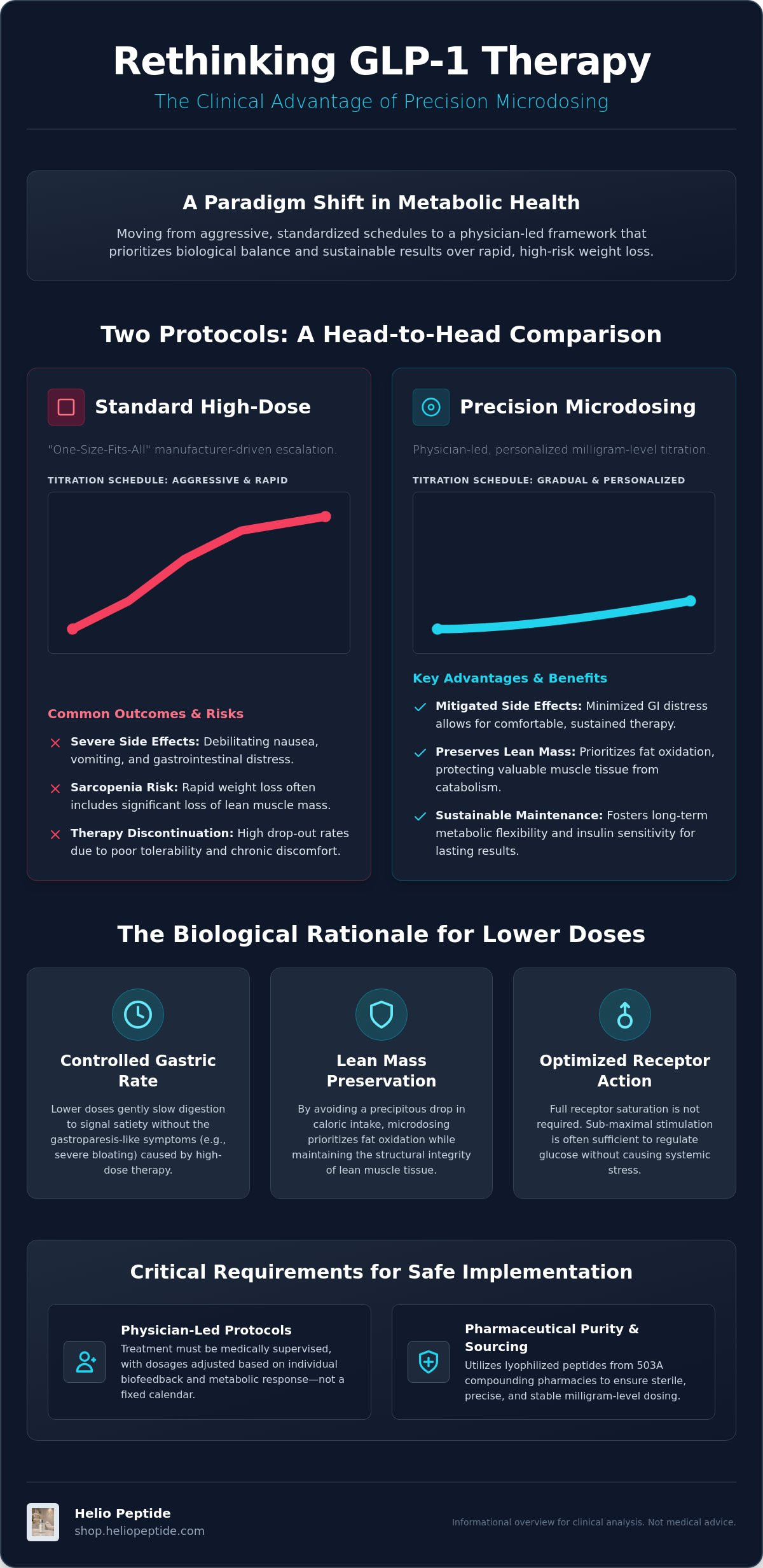
Standard manufacturer schedules, such as those utilized in the STEP clinical trial protocols, are designed for mass-market compliance rather than individual biological optimization. These programs often prioritize aggressive titration to reach "maintenance" levels as quickly as possible. This rapid increase is the primary driver of the debilitating gastrointestinal distress that many patients experience. Biological variability in receptor sensitivity means that a dose that's effective for one person may be excessive for another. Precision titration acknowledges that "micro" doses can still trigger significant satiety signals in sensitive individuals, providing the benefits of the medication without the associated lethargy or nausea.
Identifying the Microdose Threshold
Establishing a microdose threshold requires a departure from the standard 0.25mg starting point common in retail prescriptions. A true microdose is often defined as a fractional amount, perhaps as low as 0.05mg or 0.1mg, depending on the patient's baseline insulin sensitivity and previous history with peptide therapy. This process relies heavily on biofeedback and incremental adjustments. Instead of moving to a higher dose simply because a calendar date has passed, the dosage is only adjusted when the patient’s metabolic response indicates a plateau. This ensures the body remains in a state of responsive equilibrium.
GLP-1 microdosing is a method of metabolic recalibration designed to elicit the minimum effective hormonal response while preserving physiological homeostasis.
The Biological Rationale for Lower-Dose GLP-1 Protocols
High-dose therapy often results in a precipitous drop in caloric intake. This rapid weight loss is frequently associated with the loss of facial volume and skeletal muscle mass, a phenomenon that occurs when the body's demand for energy exceeds its immediate metabolic capacity. When clinicians choose to microdose glp 1, they aim for a more measured metabolic shift. This approach prioritizes fat oxidation while maintaining the structural integrity of lean tissue. Understanding how GLP-1 receptor agonists work at the cellular level reveals that full receptor saturation isn't always necessary for therapeutic benefit. In many cases, sub-maximal stimulation of the GLP-1 receptor is sufficient to regulate glucose without triggering the systemic stress associated with rapid, high-dose titration.
Gastric emptying rates are highly dose-dependent. Standard pharmaceutical doses can lead to gastroparesis-like symptoms, where food remains in the stomach for excessive periods. Lower doses provide enough modulation to slow digestion and signal satiety without causing the total stasis that leads to vomiting or severe bloating. This controlled modulation is essential for those who wish to combine therapy with the best peptides for muscle growth and fat loss, as it ensures the body can still absorb the nutrients required for muscle repair and physical performance.
Mitigating Gastrointestinal Adverse Effects
Nausea from GLP-1 agonists originates from both peripheral gastric signals and the central nervous system. Standard titration often bypasses the body's ability to adapt to these signals. Micro-titration facilitates a gradual desensitization of the hindbrain's area postrema, where GLP-1 receptors influence the emetic response. This methodical introduction significantly reduces the incidence of dyspepsia and chronic constipation. By maintaining a lower dosage, patients can avoid the debilitating side effects that often lead to the abandonment of treatment programs.
Preserving Metabolic Flexibility
Extreme caloric restriction can inadvertently trigger a metabolic slowdown, often referred to as starvation mode. High-dose protocols sometimes suppress appetite so thoroughly that patients fail to meet their basic protein and micronutrient requirements. To microdose glp 1 is to preserve metabolic flexibility by allowing for insulin sensitization and glucose homeostasis without total appetite suppression. This balance ensures the body remains responsive to nutritional cues while the medication assists in managing insulin spikes. For those seeking professional oversight, exploring physician-supervised peptide therapy can provide the clinical guidance needed to maintain these metabolic advantages while avoiding the pitfalls of over-suppression.
Microdosing vs. Standard Manufacturer Titration Schedules
The STEP clinical trial protocols established a 20-week escalation schedule, moving patients from a 0.25mg baseline to a 2.4mg maintenance dose. While this protocol proved effective for weight reduction in a controlled environment, real-world data often reveals a high rate of discontinuation due to adverse gastrointestinal events. Many patients find that the jump between doses is too aggressive for their specific endocrine system. When you microdose glp 1, the objective is to find the lowest possible dose that maintains satiety and glucose regulation. This methodology acknowledges that the standard loading dose isn't a biological requirement for everyone, but rather a simplified starting point for mass distribution.
Clinical observations suggest that a significant number of individuals don't require the maximum tolerated dose to achieve their health objectives. Some patients remain on fractional or micro doses for the entire duration of their program because their bodies achieve metabolic equilibrium at much lower concentrations. This approach challenges the assumption that more is better, focusing instead on the longevity of the treatment and the quality of the patient's daily life. By avoiding the systemic shock of rapid escalation, patients can maintain their social and professional obligations without the interference of chronic nausea.
Evaluating the STEP Trial Protocols
The standardized 0.25mg to 2.4mg escalation was designed to maximize weight loss within a specific timeframe to meet primary clinical endpoints. However, statistically significant weight loss was often observed in trial cohorts even at the intermediate 1.0mg and 1.7mg levels. The clinical trade-off is clear: standard schedules prioritize the speed of weight loss, while precision titration prioritizes the sustainability of the protocol. For many, losing weight slightly slower while feeling physically capable is a far more desirable outcome than rapid loss accompanied by debilitating side effects.
Personalization for Hyper-Responders
Identifying hyper-responders is a critical component of safe peptide management. These individuals possess a high sensitivity to GLP-1 receptor agonists and may experience immediate, profound satiety on doses as low as 0.1mg. If these patients follow a standard escalation schedule, they face an increased risk of hypoglycemia, severe fatigue, and nutrient deficiencies. Choosing to microdose glp 1 allows these sensitive individuals to reach their goal weight safely. Once they achieve their target, micro-titration serves as an effective tool for long-term maintenance, providing just enough hormonal support to prevent weight regain without requiring a full therapeutic dose.
Clinical Requirements for Safe Implementation and Sourcing
Safe implementation of a protocol to microdose glp 1 is fundamentally dependent on the quality of the pharmaceutical substrate. While retail brand-name pens are designed for high-volume delivery through fixed increments, they lack the granularity required for precision titration. Attempting to "DIY" a microdose by counting clicks on a pre-filled pen introduces significant risk of dosage inaccuracy and medication waste. Professional metabolic optimization instead relies on clinical-grade materials sourced from regulated environments. This level of advanced peptide therapy requires a rigorous commitment to purity and stability that grey-market research chemicals cannot provide.
Physician-led oversight ensures that the titration schedule remains responsive to the patient's biological feedback. This clinical framework is necessary to prevent the common pitfalls of self-administration, such as improper storage or incorrect reconstitution. When therapy is managed within a highly regulated environment, the focus shifts from mere weight loss to long-term physiological restoration. You can access clinical-grade lyophilized peptides through our secure platform to ensure your protocol meets these professional standards.
The Advantage of Lyophilized Peptides
Lyophilized peptides offer a significant advantage in terms of stability and precision. The freeze-drying process removes moisture from the peptide, preserving its molecular structure and preventing degradation during transit. Once the patient is ready to begin, the technical process of reconstitution allows for exact milligram accuracy. By controlling the volume of bacteriostatic water used, a clinician can create a concentration that makes it possible to microdose glp 1 with high-resolution syringes. This level of control is impossible with liquid-stable formulations, which are more susceptible to temperature fluctuations and structural breakdown over time.
Navigating Regulatory Standards
Understanding the distinction between 503A and 503B pharmacy oversight is critical for patient safety. 503A compounding pharmacies are highly regulated entities that produce medications for specific, individual patients under a physician's prescription. This is the gold standard for personalized titration. In contrast, 503B facilities are outsourcing facilities that manufacture large batches. For those seeking precision, 503A standards provide the necessary oversight for custom milligram adjustments. Every clinical-grade peptide should be accompanied by a third-party Certificate of Analysis (COA) to verify its purity and the absence of contaminants. Clinical oversight is non-negotiable; it is the only way to avoid the "research chemicals" trap where purity is often unverified and potentially hazardous.
The Helio Peptide Protocol: Physician-Supervised Optimization
The Helio Peptide Protocol is a dynamic clinical framework that moves beyond the static nature of traditional weight loss programs. Our board-certified physicians design personalized titration plans that account for an individual’s specific metabolic baseline and previous response to peptide therapy. By choosing to microdose glp 1, patients can integrate advanced therapeutic agents such as Retatrutide 10mg or Semaglutide into a broader health optimization strategy. This physician-led model ensures that the dosage is always aligned with the patient's current physiological state rather than a predetermined pharmaceutical calendar. Telehealth plays a vital role in this process, providing a platform for continuous metabolic monitoring and real-time protocol adjustments.
Transitioning from active weight loss to long-term healthspan optimization requires a shift in clinical focus. While the initial objective may be fat oxidation, the ultimate goal is the restoration of hormonal balance and metabolic flexibility. This transition is managed through a methodical reduction in dosage, ensuring that the patient maintains their results without becoming dependent on high-dose pharmaceutical intervention. By prioritizing biological balance, the protocol facilitates a sustainable path toward peak physical performance and longevity.
Comprehensive Metabolic Monitoring
The success of a precision titration plan is dependent on rigorous data collection. We utilize baseline bloodwork and follow-up clinical assessments to track key biomarkers, including glycemic control and inflammatory markers. This data allows our physicians to adjust protocols based on the patient's actual biological response rather than anecdotal feedback. Continuous monitoring is essential for identifying early signs of metabolic adaptation, allowing for timely intervention that preserves the efficacy of the medication. This level of professional oversight significantly reduces the risks associated with unmonitored "DIY" approaches, ensuring that the patient’s health remains the primary priority.
The Path to Sustainable Wellness
Sustainable wellness is measured by more than just a number on a scale. Our approach focuses on improving body composition, preserving lean muscle mass, and enhancing overall energy levels. When you microdose glp 1, the medication acts as a tool for behavior modification, helping to stabilize blood sugar and reduce cravings while the patient implements long-term lifestyle changes. This balance ensures that the benefits of therapy extend far beyond the duration of the prescription. Helio Peptide ensures every microdose protocol is backed by 503A quality standards, providing patients with the clinical-grade precision necessary for safe and effective health optimization. This commitment to pharmaceutical excellence and physician-led guidance defines the intersection of science and physical restoration.
Precision Metabolic Optimization and Long-Term Restoration
Precision titration represents a sophisticated evolution in endocrine management, moving beyond the limitations of mass-market dosing schedules. By choosing to microdose glp 1, you prioritize a methodical recalibration of your metabolism that emphasizes tolerability and the preservation of lean tissue. This strategy ensures that therapeutic efficacy is achieved without the systemic disruption often associated with rapid, high-dose escalation. It's a path defined by scientific rigor rather than standardized shortcuts, allowing for a more sustainable approach to hormonal health.
Success in metabolic optimization is a direct result of scientific methodology and professional accountability. Helio Peptide provides the necessary framework for this journey, offering clinical-grade peptides from 503A pharmacies and continuous oversight from board-certified physicians through our national telehealth infrastructure. These protocols ensure that your metabolic health is managed with the highest standards of safety and pharmaceutical purity. You're invited to begin your physician-supervised GLP-1 program with Helio Peptide today and take a decisive step toward sustainable, long-term health.
Frequently Asked Questions
What exactly is considered a microdose of a GLP-1 medication?
A microdose is defined as a fractional administration significantly lower than the standard 0.25mg titration baseline. In clinical practice, these doses often range from 0.05mg to 0.1mg of the active peptide. It's a sub-therapeutic amount designed to elicit a metabolic response without fully saturating receptors. This precision allows for a more granular approach to individual endocrine sensitivity.
Can I still lose weight if I am taking a dose lower than what is recommended?
Weight loss is achievable at lower doses for individuals with high GLP-1 receptor sensitivity. While manufacturer protocols target rapid reduction, micro-titration focuses on sustained fat oxidation through improved insulin sensitivity. Many patients experience effective appetite regulation and glucose control at these fractional levels. This method prioritizes the quality of weight loss and the preservation of skeletal muscle.
Is microdosing GLP-1s safer than standard dosing schedules?
Safety is enhanced through the significant reduction of gastrointestinal adverse effects like nausea and vomiting. By choosing to microdose glp 1, patients avoid the systemic shock associated with aggressive titration schedules. This gradual introduction allows the central nervous system to adapt more effectively. All protocols must remain under strict physician supervision to ensure metabolic markers are monitored correctly.
How do I talk to a doctor about trying a microdose protocol?
You should initiate a conversation by focusing on your specific tolerability concerns and metabolic goals. Discuss your desire for a precision titration schedule that prioritizes biological balance over rapid weight loss. Presenting the rationale of the minimum effective dose helps frame the discussion in a clinical context. Specialized medical facilitators are often more familiar with these personalized endocrine strategies than general practitioners.
Are there specific side effects associated with taking very low doses?
Side effects at very low doses are typically minimal but can include mild fatigue or slight changes in digestive rhythm. Because the dosage is fractional, the risk of severe gastroparesis or debilitating nausea is substantially lowered. Some patients notice a more subtle onset of satiety compared to the total suppression felt at higher doses. This allows for a more natural relationship with nutritional intake.
How do I accurately measure a microdose using lyophilized peptides?
Accurate measurement is achieved through precise reconstitution with bacteriostatic water and the use of high-resolution syringes. By calculating the milligram to milliliter ratio of the lyophilized formulation, you can administer exact fractional units. For example, a 15mg vial can be diluted to allow for 0.1mg increments. This level of precision is the cornerstone of successful micro-titration protocols.
Can I microdose if I have already been on a high dose for several months?
Transitioning to a lower dose is a common clinical strategy for maintenance or side effect management. This process, often called down-titration, requires a methodical reduction to find a new metabolic equilibrium. It's particularly useful for patients who have reached their target weight and wish to avoid the rebound effects of sudden cessation. A physician-supervised plan ensures that glucose levels remain stable during this transition.
Is microdosing more cost-effective than standard GLP-1 programs?
Microdosing can be more cost-effective because the total volume of medication consumed over time is lower. When you microdose glp 1 using high-concentration lyophilized vials, a single supply often lasts longer than a standard monthly pen. This efficiency reduces the frequency of refills while still providing necessary metabolic support. It represents a more sustainable financial model for long-term healthspan optimization and maintenance.
