
Semaglutide 15 mg Price: A Clinical Guide to Cost and Sourcing in 2026
The most expensive metabolic intervention is often the one that lacks a verifiable clinical pedigree. Many patients find themselves caught between the prohibitive costs of brand name pharmaceuticals and the significant risks associated with unregulated research peptides. You likely understand that true physical optimization requires a transparent intersection of medical oversight and pharmaceutical stability. Evaluating the semaglutide 15 mg price in 2026 demands more than a simple cost comparison; it requires a deep understanding of the distinction between clinical grade lyophilized vials and the hazardous alternatives found in the retail market.
This guide serves as a technical framework for identifying legitimate, physician supervised sources that adhere to 503A pharmacy standards. You will gain a clear perspective on the cost per milligram value of high concentration formulations and the specific regulatory factors currently influencing the market. We provide a methodical breakdown of sourcing protocols to ensure that your metabolic health strategy is both economically sustainable and clinically rigorous.
Key Takeaways
- Evaluate how high-concentration 15 mg vials provide superior cost-efficiency and protocol flexibility compared to standard retail pre-filled pens.
- Distinguish between the rigorous manufacturing standards of 503A pharmacies and the inherent risks associated with unregulated grey-market laboratories.
- Analyze the semaglutide 15 mg price to understand the long-term economic advantages of clinical-grade lyophilized formats over brand-name alternatives.
- Discover how lyophilization technology preserves peptide stability and potency, ensuring reliable outcomes for advanced metabolic optimization.
- Identify the critical role of physician-led supervision and metabolic screening in establishing a safe, sustainable, and highly effective therapeutic protocol.
Understanding the Semaglutide 15 mg Price Landscape
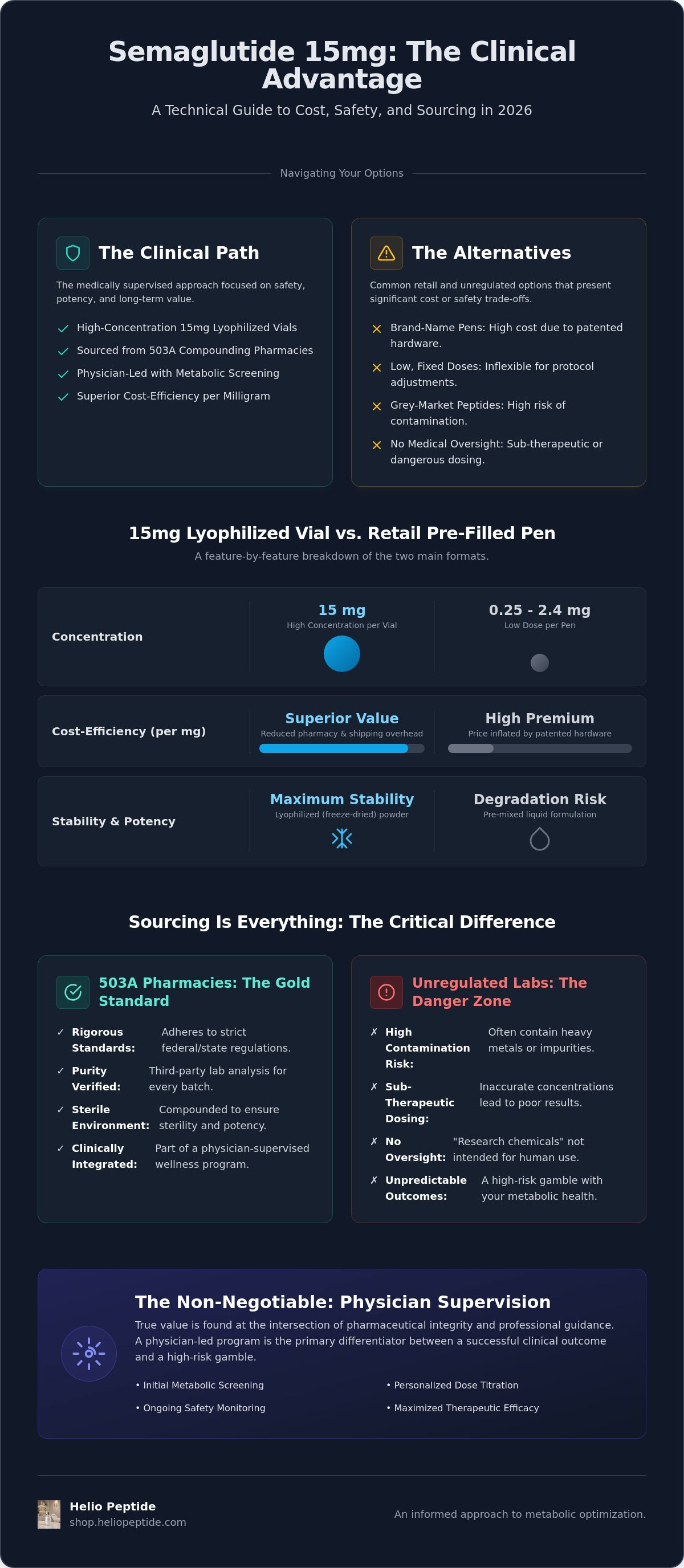
The evolution of metabolic medicine has shifted the focus toward high-concentration formats that prioritize pharmaceutical stability and patient access. While retail pharmacies emphasize pre-filled pens for convenience, clinical protocols increasingly utilize the 15 mg lyophilized vial to maximize cost-efficiency. Semaglutide, a glucagon-like peptide-1 receptor agonist, has undergone a significant market transformation since its initial introduction. The current semaglutide 15 mg price reflects a sophisticated supply chain that bypasses the mechanical overhead of disposable injection hardware, offering a more direct route to therapeutic administration.
Retail pre-filled pens carry a significant premium due to the patented delivery devices rather than the medication itself. Clinicians recognize that the efficacy of the peptide is not dependent on the plastic hardware used for administration. Transitioning to lyophilized vials allows medical facilitators to focus resources on the chemical purity and stability of the compound. This shift is particularly relevant for individuals requiring higher maintenance doses who find the monthly cost of brand-name retail products unsustainable. By 2026, the market has stabilized after years of supply volatility, making the 15 mg vial the preferred choice for self-pay patients seeking long-term metabolic control.
True value in metabolic therapy isn't found in the lowest sticker price; it's found in the intersection of pharmaceutical integrity and professional guidance. A lower price point from an unverified source often masks the hidden costs of contamination or sub-therapeutic dosing. Choosing a 15 mg vial through a physician-led program ensures that the semaglutide 15 mg price includes the necessary metabolic screenings and dose titration support required for safe results. This professional oversight is the primary differentiator between a successful clinical outcome and a high-risk gamble with research-grade chemicals.
The Economic Advantage of High-Concentration Vials
The primary driver for the adoption of the 15 mg format is the dramatic reduction in price-per-milligram. Standard retail pens typically range from 0.25 mg to 2.4 mg per unit, which necessitates frequent and expensive refills. In contrast, a 15 mg vial provides a consolidated supply that reduces the frequency of pharmacy logistics and shipping overhead. Lyophilization, or freeze-drying, ensures that the peptide remains stable during transit without the immediate degradation risks associated with liquid formulations. This stability is essential for maintaining potency throughout a multi-week protocol.
Market Variations in 2026
By 2026, the disparity between insurance-covered brand names and cash-pay clinical programs has widened. While insurance providers often restrict access through rigorous prior authorization requirements, cash-pay models offer predictable, transparent pricing for self-directed wellness. Regional pricing in the United States continues to fluctuate based on telehealth regulations and the proximity to 503A compounding facilities. Patients who prioritize clinical oversight over retail convenience often find that professional programs offer a more cohesive and cost-effective path to physical optimization.
Factors Influencing the Cost of 15 mg Lyophilized Semaglutide
The calculation of a transparent semaglutide 15 mg price involves more than the raw cost of the peptide itself. It represents a sophisticated pharmaceutical supply chain designed to ensure sterility, potency, and biological activity. Unlike standard retail medications, high-concentration lyophilized vials require specialized manufacturing environments that adhere to rigorous federal and state regulations. These overhead costs are essential for maintaining the clinical integrity of the compound, distinguishing professional-grade solutions from the high-risk alternatives found in the unregulated grey market.
Manufacturing standards serve as the primary driver of price variance. Facilities that operate under 503A designations are subject to intense scrutiny regarding their compounding processes and environmental controls. These pharmacies must verify the identity and purity of every active pharmaceutical ingredient through third-party laboratory analysis. While this level of oversight increases the baseline cost, it eliminates the substantial risks of heavy metal contamination or sub-therapeutic dosing that often plague cheaper, research-grade peptides. Selecting a clinically verified 15 mg vial ensures that these manufacturing protocols are strictly followed to protect patient health.
Logistics also play a critical role in the final cost structure. Maintaining a consistent cold-chain environment from the laboratory to the patient's door is vital for preventing the thermal degradation of the peptide chain. Temperature-controlled packaging and expedited shipping are not merely conveniences; they're clinical necessities for preserving the molecular structure of the medication. When these logistical safeguards are bypassed to lower the sticker price, the resulting product may lose significant efficacy before it even reaches the end user.
The 503A Pharmacy Premium
The premium associated with 503A pharmacies is a direct reflection of the cost of compliance. These entities must perform regular sterility testing and maintain cleanroom environments that meet USP <797> standards. Third-party lab testing for every batch provides a Certificate of Analysis, confirming that the milligram content on the label accurately reflects the contents of the vial. This transparency is absent in non-regulated sources, where "cheap" pricing often masks a complete lack of quality control.
Stability and Reconstitution
Lyophilisation is the pharmaceutical process of freeze-drying for long-term stability. This technology removes moisture from the peptide while it is frozen, creating a stable powder that resists degradation far better than liquid formulations. This format allows for a longer shelf life and greater resistance to minor temperature fluctuations during transit. Beyond the vial itself, the total cost of therapy includes the ancillary supplies required for safe administration:
- Bacteriostatic water for sterile reconstitution.
- Precision insulin syringes for accurate microdosing.
- Alcohol prep pads for maintaining injection site sterility.
Professional programs incorporate these elements into a cohesive package. Physician oversight fees further contribute to the pricing structure, ensuring that the patient's metabolic response is monitored through regular bloodwork and clinical consultations. This comprehensive approach balances medication costs with the professional guidance necessary for peak physical optimization.
Brand Name vs. Lyophilized Semaglutide: A Price Analysis
The economic disparity between mass-market pharmaceutical pens and clinical-grade lyophilized vials becomes evident when calculating the price-per-milligram efficiency. Brand-name retail products are engineered for the average consumer, often packaging the medication in proprietary, single-use delivery devices that significantly inflate the final cost. In contrast, the 15 mg lyophilized vial is designed for clinical precision and long-term metabolic protocols. Determining the true semaglutide 15 mg price requires an analysis that extends beyond the initial acquisition cost to include the total cost of ownership over a standard six-month optimization program.
Retail patients frequently encounter tiered pricing structures where the cost of the medication escalates alongside the dosage requirements. As a patient moves from a 0.25 mg induction dose to a 2.4 mg maintenance dose, the monthly financial burden often increases substantially. High-concentration vials eliminate this variable. By utilizing a 15 mg format, the price-per-milligram remains constant, allowing for a predictable budget that doesn't penalize the patient for progressing through their titration schedule. This transparency is vital for those managing their wellness through self-pay models rather than relying on the volatility of insurance coverage.
Titration and Value
The 15 mg vial supports an escalating dosage protocol without the waste inherent in fixed-dose pens. Traditional pens are often pre-set to specific increments, which can lead to unused medication or the need for multiple expensive prescriptions to achieve a specific therapeutic level. Vials offer "waste-free" dosing, enabling precise microdosing or rapid adjustments based on real-time metabolic feedback. For a detailed breakdown of these protocols, consult our guide on Semaglutide 15 mg Lyophilized: Clinical Benefits, Dosing, and Safety Protocol. This flexibility ensures that every milligram of the semaglutide 15 mg price is utilized toward your physical objectives.
Insurance and Self-Pay Realities
By 2026, the administrative hurdles of prior authorization have driven many high-performance individuals toward self-pay clinical programs. The time lost navigating insurance bureaucracy often outweighs the potential savings, especially when coverage for metabolic optimization is frequently denied or restricted. Self-pay programs provide immediate access to 503A-sourced peptides without the need for third-party mediation. When calculating the return on investment, it's essential to weigh the monthly medication cost against the long-term healthspan improvements. A stabilized metabolic profile, reduced systemic inflammation, and optimized body composition represent a significant clinical dividend that far exceeds the baseline cost of the medication.
The Value of Physician-Supervised Wellness Programmes
Seeking the lowest semaglutide 15 mg price through "research-only" chemical suppliers is a strategy fraught with clinical and legal peril. While the upfront cost of unregulated vials may appear attractive, it excludes the critical medical infrastructure required to manage a potent metabolic agonist safely. Professional oversight is the only mechanism that ensures the medication is administered within the context of your unique biological profile. A physician-led programme transforms a simple injection into a comprehensive health optimization strategy, mitigating the risks of self-prescribing unverified compounds.
The financial investment in a supervised programme covers more than the pharmaceutical agent. It incorporates the diagnostic rigor of initial bloodwork and metabolic screening, which are essential for identifying contraindications and establishing a baseline for progress. Ongoing monitoring allows for real-time protocol adjustments, ensuring that side effects are managed and that the dosage remains effective as your body composition evolves. Telehealth integration further enhances this value by reducing the significant time-cost associated with traditional clinical visits, providing professional guidance with modern efficiency.
Clinical Safety Protocols
Rigorous safety protocols begin with a thorough verification of patient medical history before any GLP-1 agonist is prescribed. This screening is vital for preventing adverse reactions and ensuring the therapy aligns with your long-term wellness objectives. One of the most significant risks of unmonitored use is the rapid loss of lean muscle mass and the development of nutritional deficiencies. Physicians utilize specific monitoring techniques to ensure that weight reduction is primarily fat-driven while preserving metabolic health. For a deeper technical analysis of these processes, review our article on Peptide Therapy for Weight Loss: A Clinical Overview of Metabolic Optimization.
Integrated Hormone Health
Metabolic optimization is rarely achieved through a single pathway. Semaglutide often demonstrates enhanced efficacy when integrated with Hormone Replacement Therapy (HRT) or Testosterone Replacement Therapy (TRT) to address underlying endocrine imbalances. This holistic approach ensures that as metabolic rate improves, hormonal levels support muscle preservation and cognitive clarity. Physician-supervised programmes optimise health outcomes beyond simple weight reduction by restoring systemic balance and improving overall vitality. You can access these professional standards by choosing to order clinical-grade semaglutide through a regulated medical facilitator.
Sourcing Clinical-Grade Semaglutide 15 mg with Helio Peptide
Securing a reliable source for metabolic optimization requires a commitment to pharmaceutical transparency and regulatory compliance. Helio Peptide operates as a specialized medical facilitator, bridging the gap between advanced peptide research and clinical application. Every 15 mg (3ml) lyophilized vial is sourced exclusively from FDA-regulated 503A pharmacies within the United States. This rigorous sourcing protocol ensures that the semaglutide 15 mg price reflects a product manufactured under strict sterile conditions, verified for both purity and potency through third-party analysis.
The Helio Peptide model prioritizes a comprehensive patient experience by integrating medication with professional oversight. Your program isn't limited to the delivery of a vial; it includes a dedicated physician consultation and ongoing clinical support to monitor your metabolic response. Unlike retail pharmacy models that often hide surcharges within complex insurance claims or device patents, our structure is defined by transparency. There are no hidden fees or tiered costs that escalate as your dosage increases. This flat-fee approach allows for precise financial planning alongside your physical transformation.
The Helio Peptide Advantage
Patients seeking peak performance require access to a diverse range of therapeutic options. Helio Peptide provides direct access to clinical-grade Retatrutide and Semaglutide, allowing for a tailored approach to metabolic health. Our wellness programmes are designed by certified physicians who specialize in endocrine balance and physical optimization. This expertise ensures that your protocol is not a generic solution but a personalized roadmap based on your specific biomarkers. National shipping is handled through efficient, temperature-controlled logistics to maintain the integrity of your medication from the laboratory to your door.
Next Steps for Patients
The journey toward optimized metabolic health begins with a methodical clinical assessment. Booking your initial telehealth consultation allows our medical team to review your history, establish health objectives, and determine the appropriateness of advanced peptide therapy. Once a prescription is issued, the delivery timeline is streamlined to ensure you can begin your protocol without unnecessary delays. Our patient support team remains available throughout your journey to assist with reconstitution technicalities or protocol adjustments. We invite you to consult with a Helio Peptide physician today to establish a secure and effective foundation for your metabolic goals.
Secure Your Metabolic Future
The evolution of weight management has moved beyond the constraints of retail pharmaceutical branding. Navigating the semaglutide 15 mg price effectively requires prioritizing clinical integrity over the convenience of pre-filled pens. By adopting a lyophilized format sourced from FDA-regulated 503A pharmacies, you secure a stable and potent compound that supports precise titration and long-term metabolic control. This methodical approach eliminates the hazards of unregulated research chemicals while providing a transparent cost structure for self-pay patients. Physician-supervised telehealth programs further enhance this value; they offer the rigorous diagnostic monitoring and hormonal integration necessary for sustainable physical optimization.
These clinical-grade solutions empower you to achieve physical restoration with the confidence that every milligram meets the highest pharmaceutical standards. Optimise your metabolic health with Helio Peptide Semaglutide 15 mg. Your commitment to a scientifically grounded protocol is the most reliable path to achieving your peak biological potential and maintaining long-term metabolic excellence.
Frequently Asked Questions
Why is semaglutide 15 mg often cheaper per milligram than lower-dose pens?
High-concentration vials eliminate the substantial mechanical overhead associated with patented, single-use injection hardware. By removing the cost of disposable delivery devices and reducing the frequency of pharmaceutical shipping, the price-per-milligram is significantly lowered. This efficiency allows patients to access a higher volume of medication without the cumulative expense of multiple low-dose pens, which are often priced based on convenience rather than chemical volume.
Is insurance likely to cover semaglutide 15 mg in 2026?
Insurance coverage for high-dose lyophilized vials remains limited in 2026, as most providers prioritize retail pens with established rebate structures. Many patients opt for self-pay programs to bypass the rigorous prior authorization hurdles and restrictive clinical criteria often required by major carriers. The transparent semaglutide 15 mg price in cash-pay models often provides better financial predictability than the fluctuating co-pays and deductibles of traditional insurance plans.
What is the difference between research-grade and clinical-grade semaglutide?
Clinical-grade semaglutide is manufactured in FDA-regulated 503A pharmacies and verified for human use through rigorous sterility and potency testing. Research-grade peptides are explicitly labeled as not for human consumption and lack the regulatory oversight required to ensure they're free from heavy metals or harmful contaminants. Choosing clinical-grade medication is the only way to guarantee pharmaceutical integrity and patient safety under the supervision of a licensed physician.
How long does a 15 mg vial of semaglutide typically last?
A 15 mg vial typically lasts between six and twelve weeks, depending on the specific maintenance dose prescribed by your medical facilitator. For example, a patient on a 1.0 mg weekly dose would utilize the vial for approximately fifteen weeks of treatment. This longevity contributes to the overall efficiency of the semaglutide 15 mg price by reducing the frequency of pharmacy orders and temperature-controlled shipping logistics.
Are there additional costs for reconstitution supplies?
Yes, the total cost of therapy includes ancillary supplies such as bacteriostatic water, precision insulin syringes, and alcohol prep pads. While some professional programs bundle these items into the initial fee, they're necessary for the sterile administration of lyophilized peptides. Ensuring you have high-quality medical supplies is vital for maintaining the sterility of the reconstituted solution throughout the entire duration of the vial's use.
Can I switch from a 2.4 mg pen to a 15 mg lyophilized vial?
Patients can transition from retail pens to lyophilized vials under the guidance of a licensed physician to ensure dosage accuracy. This switch often requires a clinical consultation to confirm the current metabolic response and establish a corresponding titration schedule for the vial format. Vials allow for more precise microdosing, which can be beneficial for patients who experienced adverse effects on the fixed-dose increments of retail pens.
What happens if I need to increase my dose while on a 15 mg programme?
Increasing your dose is a seamless process within a 15 mg program because the vial format naturally supports flexible titration. Since the chemical concentration remains constant, your physician will simply adjust the volume of the injection rather than requiring a new, more expensive prescription. This flexibility is a primary advantage over retail pens, which require a completely different product for every incremental dose escalation.
How do I verify if a pharmacy is a legitimate 503A facility?
You can verify a pharmacy's status by checking the state board of pharmacy records in the jurisdiction where the facility is located. Legitimate 503A pharmacies are licensed to compound patient-specific prescriptions and must adhere to strict USP standards for sterile preparations. Helio Peptide ensures that all medication is sourced from verified US-based facilities that maintain active licenses and pass regular, rigorous regulatory inspections.
