How to Reconstitute 10mg Retatrutide: A Clinical Precision Guide (PDF)
The moment you hold a vial of lyophilized peptide and a syringe, the question stops being theoretical. How much bacteriostatic water do you add? Where exactly does the needle go? What happens if you get the math wrong? Searching for a reliable guide on how to reconstitute 10mg retatrutide pdf leads most people to fragmented forum posts and conflicting dosage tables, none of which carry the clinical weight a procedure like this demands.
That anxiety is entirely justified. Reconstitution isn't simply mixing a powder with water. It's a sterile pharmaceutical procedure where volumetric precision, contamination control, and proper storage all determine whether the final preparation is safe and effective, or compromised before a single dose is drawn.
This guide addresses that directly. You'll find exact bacteriostatic water ratios for a 10mg vial, step-by-step aseptic technique, unit conversion logic for insulin syringes, and clinical storage standards, presented in a clear, printable format designed for practical use at the point of preparation. The methodology here is grounded in pharmaceutical protocol, not guesswork.
Key Takeaways
- Retatrutide is shipped as a lyophilized powder to preserve molecular integrity during transit and storage — understanding this distinction is foundational before any reconstitution procedure begins.
- The volume of bacteriostatic water added to a 10mg vial determines concentration, not total peptide content — a critical calculation that directly governs every dose drawn from that vial.
- This guide functions as a printable clinical reference on how to reconstitute 10mg retatrutide pdf, covering aseptic technique, exact BAC water ratios, and insulin syringe unit conversions in a single structured protocol.
- Reconstituted Retatrutide requires refrigeration within a precise temperature range and protection from light exposure — deviations from these storage standards compromise peptide stability and therapeutic efficacy.
- Sourcing from a 503A-compliant compounding pharmacy under physician supervision is not optional — it is the clinical and regulatory standard that separates safe, verified therapy from uncontrolled research-grade compounds.
Understanding Lyophilized Retatrutide 10mg and Reconstitution
Retatrutide represents a sophisticated class of pharmaceutical compounds known as triple-agonist peptides. In its 10mg presentation, the substance is provided as a lyophilized powder rather than a pre-mixed liquid. This state isn't a matter of convenience. It's a structural requirement for molecular integrity. Reconstitution is the clinical process of introducing a precise volume of diluent to this solid to create an injectable solution. Understanding the components of this process, including the 10mg vial, bacteriostatic water, and isopropyl alcohol swabs, is the first step for anyone seeking a guide on how to reconstitute 10mg retatrutide pdf for clinical use. Without this transition from solid to liquid, the peptide remains biologically inactive and cannot be administered through standard subcutaneous routes.
The Science of Lyophilization
Lyophilization, or freeze-drying, is a dehydration process used to preserve perishable materials by freezing them and then reducing the surrounding pressure to allow the frozen water to sublimate. For a triple-agonist peptide that targets GIP, GLP-1, and Glucagon receptors, this process is vital. It locks the delicate amino acid chains into a stable matrix, preventing degradation from heat or kinetic energy during shipping. A high-quality 10mg vial will often contain a solid, disc-shaped "cake" or a fine white powder. This substance is sealed under a vacuum to further minimize oxidation. If the cake appears melted, shrunken, or discolored, the vacuum seal may have been compromised. This usually suggests that the peptide's structural stability is no longer guaranteed and the efficacy of the medication may be reduced.
Bacteriostatic Water vs. Sterile Water
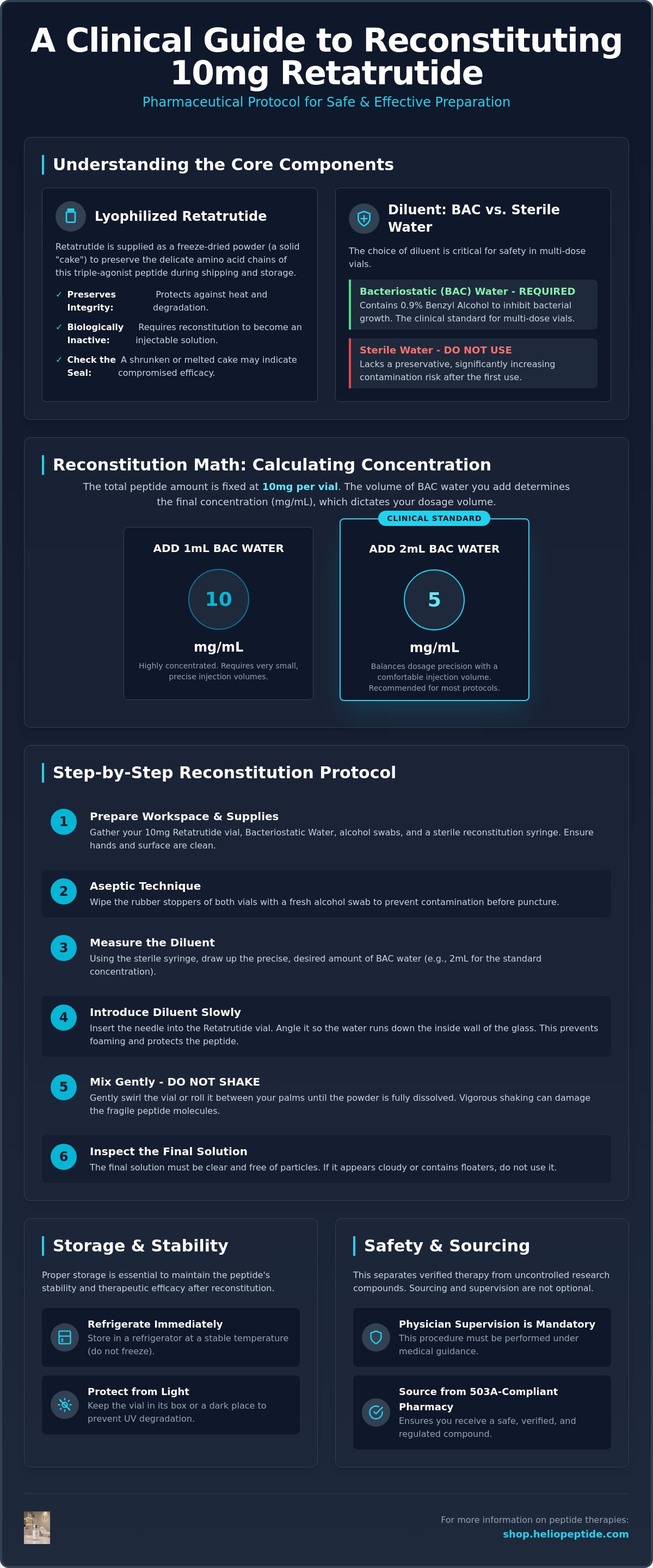
Selecting the correct diluent is a safety requirement that shouldn't be overlooked. Bacteriostatic water is the clinical standard for multi-dose vials because it contains 0.9% benzyl alcohol. This additive acts as a bacteriostatic preservative, inhibiting the growth of potentially harmful bacteria that could be introduced during repeated needle punctures. In contrast, plain sterile water for injection lacks this preservative. Using sterile water in a 10mg vial intended for multiple doses significantly increases the risk of microbial contamination after the first use. For any protocol involving how to reconstitute 10mg retatrutide pdf, the use of bacteriostatic water is mandatory to ensure the solution remains sterile and safe for the duration of its use. This distinction is a cornerstone of patient safety in peptide therapy.
Retatrutide Reconstitution Math: BAC Water Ratios
Precision in reconstitution math is a prerequisite for therapeutic safety. The total mass of the peptide remains a constant 10mg regardless of the diluent volume introduced; however, the concentration, expressed in milligrams per milliliter (mg/mL), shifts based on the amount of bacteriostatic water added. When reviewing a protocol on how to reconstitute 10mg retatrutide pdf, the primary objective is to select a volume that allows for high-resolution measurement on a syringe. Excessive dilution leads to large injection volumes that may cause localized discomfort, while insufficient dilution makes accurate micro-dosing difficult. Adding 2mL of diluent to a 10mg vial results in a concentration of 5mg per 1mL. This 5:1 ratio is widely considered the clinical standard for 10mg vials because it balances volumetric precision with ease of administration.
According to FDA guidelines on lyophilization, the accuracy of the final dosage is entirely dependent on the homogeneity of the reconstituted solution and the precision of the diluent measurement. Using a calibrated syringe to introduce the bacteriostatic water ensures that the math remains consistent across multiple vials. Discrepancies in the volume of the diluent will lead to dosage errors that could compromise the entire therapeutic cycle.
Concentration Comparison Table
The following ratios illustrate how different volumes of bacteriostatic (BAC) water alter the final concentration of a 10mg vial:
- 1mL BAC Water: 10mg/mL concentration. This results in a highly concentrated solution requiring very small, high-precision injection volumes.
- 2mL BAC Water: 5mg/mL concentration. This is the standard clinical ratio for 10mg vials and simplifies the majority of dosing protocols.
- 3mL BAC Water: 3.33mg/mL concentration. This lower concentration is typically utilized for protocols requiring precise micro-dosing adjustments.
Calculating Your Dose in Units
Translating milligrams into units on an insulin syringe requires a clear understanding of volumetric conversion. Standard U-100 syringes are calibrated so that 100 units equal exactly 1.0mL of liquid. When utilizing the standard 2mL reconstitution ratio (5mg/mL), each 10-unit mark on the syringe represents 0.5mg of medication. For instance, to administer a 2mg dose from a 2mL/10mg reconstitution, the plunger should be drawn to the 40-unit mark. For a deeper understanding of how these concentrations align with therapeutic goals, refer to the Retatrutide 10mg: The Triple-Agonist Evolution in Clinical Peptide Therapy analysis. Maintaining this level of mathematical rigor ensures that the physical optimization process remains grounded in clinical safety. If you are ready to begin your protocol, ensure you have sourced high-purity lyophilized peptides from a reputable provider.
Step-by-Step Retatrutide Reconstitution Protocol
Reconstitution requires a disciplined adherence to aseptic technique to prevent bacterial contamination and preserve molecular integrity. This protocol provides a structured methodology for those seeking a guide on how to reconstitute 10mg retatrutide pdf for clinical consistency. As noted in Retatrutide clinical trial information, this compound is intended for subcutaneous administration, making the sterility of the reconstituted solution a primary safety concern. Every step must be executed with precision to ensure the final preparation is both safe and effective.
Establishing a sterile field is the first requirement for clinical preparation. Sanitize a flat, non-porous surface with a disinfectant and wash hands thoroughly with antimicrobial soap. Remove the plastic caps from both the 10mg Retatrutide vial and the bacteriostatic water. Swab the rubber stoppers with 70% isopropyl alcohol, using a firm, circular motion. Allow the alcohol to air-dry completely before proceeding to ensure the surface is chemically decontaminated. Use the "Slow Drip" technique when introducing the diluent; aim the needle tip toward the inner glass wall of the vial rather than directly at the powder cake. This allows the bacteriostatic water to run down the side of the glass, gently saturating the lyophilized material and preventing mechanical stress.
Managing the Vacuum
Many pharmaceutical vials are packaged under a vacuum to maintain long-term stability. When the needle penetrates the stopper, the vacuum may attempt to pull the diluent in rapidly. You must control the plunger with a firm grip to counteract this force. A sudden influx of liquid can create high-pressure turbulence, potentially damaging the delicate peptide chains. If significant resistance is felt when withdrawing the needle later, or if the vial feels pressurized, venting the vial by drawing a small amount of air into an empty syringe and inserting it can equalize the internal environment, preventing the solution from spraying out during subsequent access.
The "Swirl, Don’t Shake" Rule
Peptides are fragile chains of amino acids that are highly susceptible to shear force. Once the bacteriostatic water is introduced, use a gentle, horizontal swirling motion to dissolve the lyophilized cake. Never shake the vial. Shaking introduces air bubbles, leading to foaming and the potential denaturation of the protein structure. Denaturation renders the peptide biologically inactive, effectively destroying the medication's therapeutic value. A successful reconstitution ends with a rigorous visual inspection; the final solution must be entirely clear, colorless, and free of particulates. If the liquid appears cloudy or shows persistent foaming that does not dissipate after several minutes of rest, the vial's integrity may be compromised.
Storage, Stability, and Clinical Handling
The stability of a triple-agonist peptide is not guaranteed by reconstitution alone; it requires strict adherence to post-preparation storage standards. Once the lyophilized powder is introduced to bacteriostatic water, the molecular structure becomes significantly more vulnerable to environmental stressors and thermal variance. Maintaining the vial within a precise temperature range of 36°F to 46°F is mandatory to prevent thermal degradation. This section of the how to reconstitute 10mg retatrutide pdf protocol focuses on these clinical handling requirements to ensure the medication remains biologically active for the duration of its use. Deviations from this temperature range can lead to a rapid loss of potency.
Photodegradation is another critical risk factor that often goes unaddressed. Retatrutide is light-sensitive, meaning prolonged exposure to UV or even standard indoor lighting can break down the delicate peptide bonds. Vials should always be stored in their original carton or an opaque container within the refrigerator to block light exposure. Under these optimal conditions, the reconstituted solution typically maintains its stability for a window of 28 to 30 days. Beyond this timeframe, the risk of molecular breakdown and potential bacterial growth increases, even with the presence of benzyl alcohol in the diluent. It's vital to remember that while lyophilized powder can sometimes be stored in a freezer, you must never freeze the peptide once it has been reconstituted. Freezing creates ice crystals that can physically shear the amino acid chains, rendering the solution ineffective.
Signs of Degradation
Visual monitoring is an essential component of clinical oversight. The solution should remain perfectly clear and colorless throughout its 30-day shelf life. Any deviation from this state indicates a compromise in stability or sterility. If you observe any of the following, the vial should be discarded:
- Cloudiness: A milky or hazy appearance often suggests bacterial contamination or significant protein denaturation.
- Particulates: The presence of "floaties" or undissolved matter indicates that the peptide has fallen out of solution or has been contaminated.
- Discoloration: Any yellowing or tinting of the liquid is a definitive sign of chemical degradation.
If a vial is accidentally left at room temperature for more than a few hours, its stability is compromised. High ambient temperatures accelerate the rate of peptide breakdown, which can significantly reduce the efficacy of the medication before the next scheduled dose.
Travel and Transport
Maintaining the cold chain during transit is necessary for those who must transport their medication. Use insulated medical pouches equipped with gel packs to ensure the temperature remains within the required 36°F to 46°F range. Kinetic agitation should also be minimized; excessive shaking during travel can lead to foaming and mechanical stress on the peptide chains. For more detailed information on managing these complex biological compounds, consult our Advanced Peptide Therapy: A Clinical Reference for Health Optimization. To ensure your protocol begins with the highest quality materials, you can order Retatrutide (10mg) from our clinical-grade inventory.
The Importance of 503A Sourcing and Physician Supervision
Mastering the technical steps of how to reconstitute 10mg retatrutide pdf is only half of the clinical equation. The biochemical integrity of the solution depends entirely on the quality of the lyophilized powder sourced before the first drop of bacteriostatic water is added. A clear distinction exists between "research grade" substances and "clinical grade" peptides prepared by 503A compounding pharmacies. Research chemicals are often produced in facilities that lack stringent regulatory oversight, leading to variations in potency and the presence of residual solvents. Clinical-grade peptides are synthesized under current Good Manufacturing Practice (cGMP) standards, ensuring that the molecular structure is identical to the intended therapeutic design and free from bacterial endotoxins.
Triple-agonist therapy, which targets the GLP-1, GIP, and Glucagon receptors simultaneously, requires a high degree of physiological monitoring. These pathways influence insulin secretion, gastric emptying, and lipid metabolism in a complex, synergistic manner. Attempting to manage this therapy without physician oversight increases the risk of metabolic imbalance or improper titration. Unverified sources often carry hidden risks, such as heavy metal contamination or inaccurate concentration levels, which can render even the most precise reconstitution protocol dangerous. Professional guidance ensures that the therapy is tailored to individual health markers and that any adverse reactions are managed with clinical expertise.
Why Clinical Purity Matters
The standard for pharmaceutical-grade peptides is established through High-Performance Liquid Chromatography (HPLC) and Mass Spectrometry. These tests verify that the peptide purity exceeds 99%, ensuring that no truncated sequences or impurities remain in the vial. 503A pharmacies operate in sterile compounding environments that meet USP <797> standards, which are designed to prevent the introduction of microbes during the manufacturing process. For a comprehensive look at the regulatory landscape and safety standards, refer to our guide on Retatrutide Peptide Buy Online: A Clinical Guide to Sourcing and Physician Supervision. Using a verified source is the only way to guarantee that the 10mg of medication stated on the label is exactly what is delivered to the biological system.
The Helio Peptide Advantage
Helio Peptide functions as a specialized medical facilitator, bridging the gap between advanced science and physical optimization. Our programs provide access to US-licensed physicians who oversee every aspect of the wellness journey, from initial screening to ongoing protocol adjustments. By sourcing exclusively from FDA-regulated manufacturers and 503A-compliant pharmacies, we ensure that every vial meets the highest standards of safety and efficacy. Helio Peptide provides clinical-grade 10mg Retatrutide with full physician-led support. This rigorous approach removes the uncertainty of unregulated markets, allowing you to focus on achieving peak performance through a transparent and highly regulated medical framework.
Precision Protocols for Peak Physical Optimization
Adherence to clinical protocol is the primary safeguard against contamination and molecular degradation. By mastering the aseptic technique and volumetric math outlined in this guide, you ensure that every dose remains biologically active and stable. This structured approach on how to reconstitute 10mg retatrutide pdf serves as a foundation for physical optimization; it moves beyond guesswork to achieve pharmaceutical-grade results. Success in peptide therapy is never accidental. It is the direct consequence of rigorous handling and professional oversight.
Sourcing your medication from 503A-compliant pharmacies and operating under licensed medical guidance are the final steps in securing your long-term health objectives. Helio Peptide provides the necessary framework for this transition, offering third-party lab-verified purity and dedicated clinician support to manage your triple-agonist protocol with absolute confidence. Our commitment to regulatory standards ensures that your results are grounded in safety and clinical authority.
Start Your Physician-Supervised Retatrutide Program at Helio Peptide to access the highest standards of clinical care and verified purity. You are now equipped to manage your therapy with the precision it demands.
Frequently Asked Questions
How much bacteriostatic water should I add to 10mg of Retatrutide?
The clinical standard for a 10mg vial is 2mL of bacteriostatic water. This ratio creates a concentration of 5mg per 1mL, which allows for precise dosage measurements on a standard U-100 insulin syringe. While some protocols may use 1mL or 3mL, the 2mL volume is preferred because it balances injection comfort with mathematical simplicity.
Can I use sterile water instead of bacteriostatic water for reconstitution?
Sterile water is not recommended for vials intended for multiple doses. It lacks the 0.9% benzyl alcohol preservative found in bacteriostatic water, which is necessary to inhibit bacterial growth after the initial puncture of the stopper. Using plain sterile water significantly increases the risk of contamination during the 30-day storage period.
What happens if I shake the Retatrutide vial by mistake?
Shaking the vial introduces shear force that can denature the delicate amino acid chains of the peptide. This mechanical stress often leads to foaming and may render the medication biologically inactive. If accidental shaking occurs, let the vial rest in the refrigerator until the bubbles dissipate before conducting a visual check for clarity.
How long is Retatrutide stable after it has been mixed?
Reconstituted Retatrutide maintains its molecular integrity for 28 to 30 days when stored under proper refrigeration. It must be kept between 36°F and 46°F and shielded from light exposure. Beyond this 30-day window, the potency of the triple-agonist begins to decline, and the risk of microbial contamination in the vial increases.
Does the amount of water I add change the strength of the dose?
The total mass of 10mg remains constant regardless of the diluent volume introduced into the vial. Adding more or less water only changes the concentration, or the amount of medication present in each milliliter. Understanding this distinction is vital when following a guide on how to reconstitute 10mg retatrutide pdf, as it determines the exact unit markings required for your draw.
Should Retatrutide be clear or cloudy after mixing?
A successfully reconstituted solution must be perfectly clear, colorless, and free of any visible particulates. Cloudiness or a milky appearance indicates that the peptide has denatured or that the solution is contaminated. If the liquid doesn't remain transparent after gentle swirling, it should be discarded to ensure patient safety and therapeutic efficacy.
Can I pre-fill syringes for the entire month after reconstituting?
Pre-filling syringes for extended periods is generally discouraged because the peptide can adhere to the plastic walls or react with the needle's adhesive. It's best to store the solution in its original glass vial and draw each dose immediately before administration. If you must pre-fill for short-term travel, ensure the syringes are kept refrigerated and used within 48 hours.
Is it normal for the vial to have a vacuum that pulls the water in?
A vacuum seal is a standard manufacturing feature of clinical-grade lyophilized peptides. It ensures the powder remains in an oxygen-free environment to prevent oxidation during storage. When you insert the needle, you should maintain a firm grip on the plunger to control the flow, preventing the bacteriostatic water from rushing in and damaging the peptide.
