
Retatrutide 10mg Dosage Chart: Clinical Titration and Reconstitution Guide
Clinical data from the TRIUMPH-1 Phase 3 trials indicates that participants utilizing a 12mg weekly dose achieved an average weight loss of 28.3 percent over 80 weeks. This level of metabolic optimization, which rivals bariatric surgical outcomes, underscores the profound potency of triple-agonist therapy. However, the transition from clinical theory to practical administration often introduces significant technical hurdles. It's common for practitioners and patients to face confusion when translating lyophilized mass into actionable syringe units.
This guide provides a definitive retatrutide 10mg dosage chart to eliminate calculation errors and ensure adherence to established clinical titration schedules. We will examine the precise mathematics of reconstitution and the physiological rationale behind a gradual escalation protocol. You will gain a clear understanding of the conversion from milligrams to units on a standard syringe, alongside a comprehensive week by week plan designed to mitigate common gastrointestinal side effects. This analysis serves as a professional resource for understanding the rigorous standards required for advanced metabolic health and the safe handling of this investigational compound.
Key Takeaways
- Understand the triple-agonist mechanism of Retatrutide and why the 10mg lyophilized vial serves as the clinical standard for dose flexibility.
- Utilize a comprehensive retatrutide 10mg dosage chart to follow a structured titration protocol, starting with a 2.0 mg initiation phase to assess metabolic tolerance.
- Master the technical math of reconstitution, including the specific volume of bacteriostatic water needed to achieve precise unit measurements on a U-100 syringe.
- Implement physician-led protocols for managing gastrointestinal side effects by adhering to a methodical four-week escalation cycle.
- Recognize the importance of sourcing clinical-grade peptides from regulated manufacturers to ensure high purity and consistent therapeutic outcomes.
Understanding the Retatrutide 10mg Clinical Protocol
Retatrutide represents a sophisticated evolution in the pharmacological management of metabolic health. As a first-in-class triple hormone receptor agonist, it targets three distinct pathways simultaneously: Gastric Inhibitory Polypeptide (GIP), Glucagon-Like Peptide-1 (GLP-1), and Glucagon. This unimolecular compound, often referred to as Retatrutide (LY-3437943), offers a more comprehensive physiological intervention than the dual-agonist profiles found in previous generations of therapy. The transition to triple-agonist therapy necessitates a rigorous adherence to a retatrutide 10mg dosage chart to ensure both patient safety and therapeutic efficacy. Physician-supervised programs are essential for monitoring cardiovascular responses and metabolic shifts as the body adapts to this potent hormonal modulation.
The Triple-Agonist Mechanism Explained
The efficacy of this peptide is rooted in its multi-receptor synergy. GLP-1 and GIP receptors work in tandem to enhance insulin sensitivity and promote significant appetite suppression through neuroendocrine signaling. The inclusion of the Glucagon receptor agonist is the defining feature of this therapy. While GLP-1 and GIP focus primarily on caloric intake and glycemic control, Glucagon stimulates energy expenditure and promotes thermogenesis within the adipose tissue. This dual-action approach on both intake and output creates a metabolic environment that is highly conducive to weight reduction. Because three separate pathways are being stimulated, the titration process must be more precise than that of single or dual agonists to maintain physiological balance.
Why 10mg Lyophilized Vials are the Preferred Format
Stability and precision are the primary reasons why the 10mg lyophilized format has become the clinical standard. Lyophilization, or freeze-drying, removes moisture from the peptide to prevent hydrolysis and chemical degradation. This process ensures that the compound remains biologically active and potent until it's reconstituted for administration. The 10mg vial size is strategically chosen to facilitate multi-week titration cycles. It provides the necessary mass for the gradual dose increases required by a standard retatrutide 10mg dosage chart without the waste or degradation issues seen in larger volume containers. Sourcing these compounds through 503A compounding pharmacies is critical for maintaining pharmaceutical-grade purity. These regulated facilities adhere to strict manufacturing standards, ensuring that every vial is free from contaminants and accurately dosed. This level of oversight is vital for patients who are navigating the complexities of advanced peptide therapy under professional guidance.
Retatrutide 10mg Dosage Chart: Weekly Titration Schedule
Adherence to a methodical titration schedule is the cornerstone of safe retatrutide administration. Because this peptide engages three distinct hormonal pathways, the body requires a period of physiological adaptation to prevent overwhelming the gastrointestinal and cardiovascular systems. A standard retatrutide 10mg dosage chart serves as a clinical roadmap, guiding the transition from sub-therapeutic initiation to full metabolic optimization. The objective isn't to reach the maximum dose as quickly as possible, but rather to find the lowest effective dose that yields the desired metabolic results while maintaining patient comfort.
Standard Titration Schedule for 2026
Clinical protocols established in 2026 emphasize a conservative escalation strategy to manage receptor saturation. Most programs follow a four-week "dwell time" at each dosage level before considering an increase. This duration allows the peptide to reach a steady-state concentration in the plasma, providing a clear picture of the patient's long-term tolerance. The standard progression typically includes these milestones:
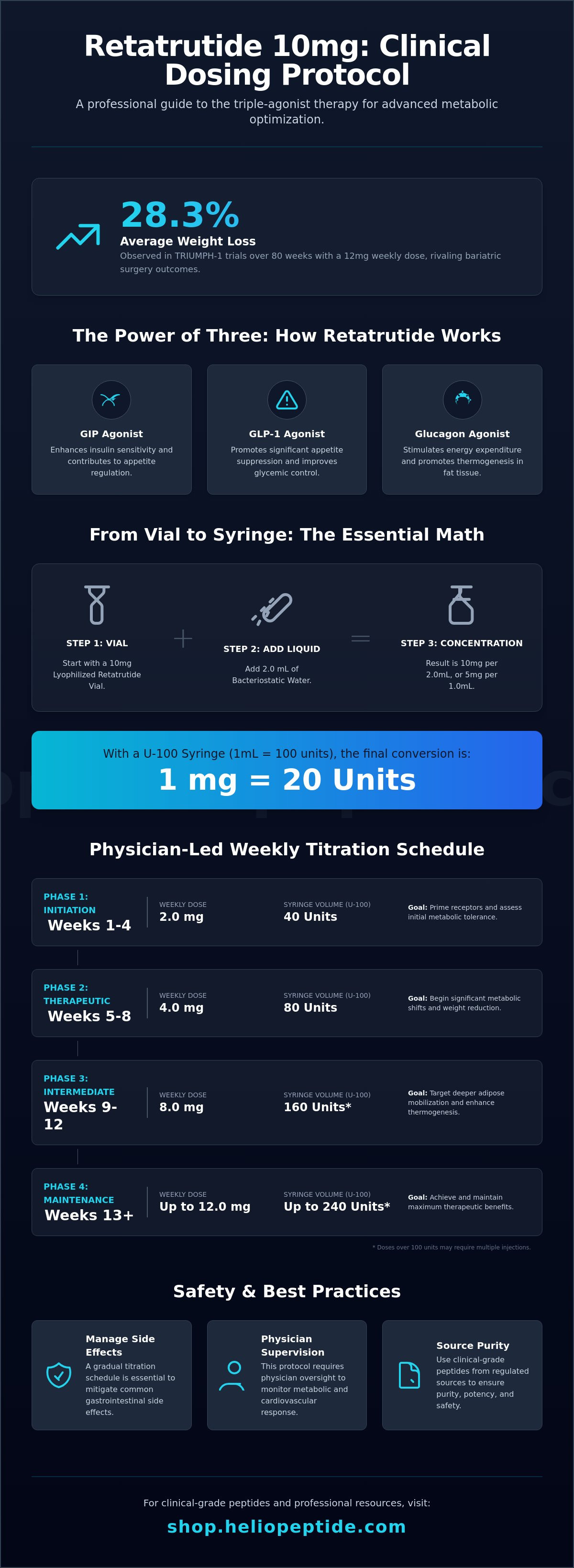
- Weeks 1 through 4: 2.0 mg weekly. This initiation phase is designed to prime the GIP and GLP-1 receptors without triggering acute distress.
- Weeks 5 through 8: 4.0 mg weekly. This early therapeutic phase often marks the beginning of significant metabolic shifts.
- Weeks 9 through 12: 8.0 mg weekly. The intermediate phase targets deeper adipose tissue mobilization and enhanced thermogenesis.
- Weeks 13 and Beyond: Up to 12.0 mg weekly. This represents the maintenance ceiling for most clinical applications.
Physicians may choose to delay a scheduled increase if a patient reports persistent nausea or if biomarkers, such as resting heart rate, show unexpected fluctuations. If a patient achieves their health objectives at 4.0 mg or 8.0 mg, there is often no clinical necessity to escalate to the 12.0 mg maximum.
Customizing the Schedule for Sensitivity
Clinical flexibility is essential for patients who exhibit high sensitivity to hormone receptor agonists. Some individuals may experience significant appetite suppression or side effects at the very first 2.0 mg dose. In these instances, a physician might recommend a micro-titration approach, which involves maintaining the initiation dose for an extended period or increasing by smaller increments. Monitoring for signs of delayed gastric emptying or excessive fatigue is paramount. When planning your titration, it's vital to source clinical-grade peptides that offer the purity required for such precise dosing. This oversight ensures that any adjustments to the retatrutide 10mg dosage chart are based on the patient's unique physiological response rather than inconsistencies in the compound itself.
Clinical Rationale: Managing Triple-Agonist Side Effects
While the adverse effect profile of triple-agonists shares similarities with traditional GLP-1 therapies, the addition of glucagon receptor activation introduces unique physiological considerations. The clinical objective of a structured retatrutide 10mg dosage chart is to balance aggressive metabolic stimulation with systemic tolerance. Unlike dual-agonists that primarily focus on insulin secretion and gastric delay, retatrutide's glucagon component increases energy expenditure and thermogenesis. This multi-pathway approach requires a more nuanced management strategy to ensure that the patient's cardiovascular and gastrointestinal systems aren't overwhelmed during the escalation process.
Gastrointestinal Tolerance and Titration
The 2mg initiation dose is a critical clinical threshold designed to prevent acute emesis and severe nausea. By starting at this low concentration, the body can gradually adapt to the significant delay in gastric emptying that characterizes this class of peptides. Patients often experience the most pronounced symptoms within the first 48 hours post-injection. During this window, dietary adjustments are essential. Consuming small, low-fat, and nutrient-dense meals can significantly mitigate distress. Clinical observation suggests that side effects typically follow a predictable arc; they tend to peak during the first two weeks of a new dose and subside by week three. This "steady-state" stabilization is the primary reason why the four-week intervals on a retatrutide 10mg dosage chart are vital for long-term adherence and patient comfort.
Cardiovascular and Metabolic Monitoring
Glucagon activation exerts a distinct influence on the cardiovascular system, often manifesting as a modest increase in resting heart rate. While this is a documented pharmacological response, it necessitates consistent monitoring to ensure the rate remains within clinically acceptable parameters. This is particularly important for patients concurrently enrolled in physician-led TRT or HRT programs. The synergistic effect of exogenous hormones and triple-agonist therapy can accelerate metabolic rate, potentially requiring adjustments to existing medication protocols to maintain homeostasis. During the 12mg maintenance phase, clinicians should prioritize the tracking of specific biomarkers, including blood pressure, fasting insulin, and electrolyte levels. Maintaining rigorous hydration and a high-protein nutritional intake supports these rapid metabolic shifts and helps preserve lean muscle mass during periods of intensive adipose tissue mobilization.
Reconstitution and Unit Conversion for 10mg Vials
Reconstitution is the clinical process of restoring a lyophilized peptide to its liquid state for administration. This procedure requires a high degree of precision to ensure the final concentration aligns with the intended therapeutic dose. Because retatrutide is provided as a 10mg freeze-dried mass, the volume of Bacteriostatic (BAC) water introduced into the vial dictates the mathematics of every subsequent injection. Practitioners must follow a rigorous retatrutide 10mg dosage chart to avoid sub-therapeutic or supra-therapeutic dosing errors. Accuracy during this stage is the primary safeguard against the gastrointestinal distress associated with accidental over-administration.
Unit Calculation for Common Dilutions
Calculating dosage on a standard U-100 insulin syringe depends entirely on the total volume of diluent used. A U-100 syringe is calibrated so that 100 units equal 1.0ml of fluid. When managing a 10mg vial, the following conversion protocols apply:
- 1.0ml Dilution: If you add 1.0ml of BAC water to a 10mg vial, the concentration becomes 1.0mg per 10 units. Therefore, a 2.0mg initiation dose requires 20 units on the syringe.
- 2.0ml Dilution: If you add 2.0ml of BAC water to a 10mg vial, the concentration is halved to 0.5mg per 10 units. In this scenario, a 2.0mg dose requires 40 units on the syringe.
When using a 1.0ml dilution, the mathematical ratio is a direct one-to-ten conversion where every ten units on the syringe represents exactly one milligram of the peptide.
Aseptic Administration Protocol
Maintaining a sterile environment is mandatory to prevent bacterial contamination of the multi-dose vial. Before reconstitution, the rubber stopper of the 10mg vial and the top of the BAC water container must be sanitized with 70% isopropyl alcohol. When introducing the diluent, the needle should be aimed at the side of the glass vial rather than directly at the lyophilized powder to prevent degradation of the peptide chains. You shouldn't shake the vial; instead, gently swirl the container until the solution is clear and free of visible particulates. Once the solution is reconstituted, it must be stored in a refrigerated environment between 2°C and 8°C to maintain 100% peptide integrity.
Subcutaneous injections are typically administered into the adipose tissue of the abdomen, thigh, or upper arm. It's essential to rotate injection sites weekly to optimize absorption and prevent localized tissue irritation. All used syringes and needles must be disposed of in a designated sharps container in compliance with medical safety standards. To ensure the highest level of therapeutic reliability, you can order clinical-grade retatrutide 10mg vials that meet stringent purity specifications. Following these aseptic steps alongside an accurate retatrutide 10mg dosage chart ensures that the transition from reconstitution to administration remains safe and clinically effective.
Sourcing Clinical-Grade Retatrutide 10mg via Helio Peptide
The peptide marketplace is currently saturated with vendors offering "research-grade" compounds that bypass essential regulatory oversight. These products are often manufactured in facilities that lack the rigorous sterilization and quality control standards required for human administration. Utilizing unregulated substances carries significant risks, including exposure to heavy metals, bacterial contaminants, or inconsistent concentrations. For those committed to physical optimization, sourcing through a legitimate 503A compounding pharmacy is the only viable path to ensuring systemic safety. Helio Peptide prioritizes clinical integrity by partnering exclusively with US-licensed manufacturers to deliver peptides with a verified purity of 99% or higher.
The 503A Pharmacy Standard
Adherence to FDA-regulated sourcing is a non-negotiable requirement for professional metabolic health management. Every batch of retatrutide undergoes comprehensive third-party testing to secure a Certificate of Analysis (COA). This document provides quantitative proof of the compound’s identity, potency, and purity levels. Transparency in the manufacturing chain allows patients and physicians to proceed with absolute confidence in the chemical composition of the 10mg vials. This level of scrutiny is what differentiates a professional wellness facilitator from a standard retail vendor. It ensures that the metabolic response observed is a result of the peptide's pharmacological action rather than an adverse reaction to impurities.
Starting Your Supervised Program
Accessing advanced peptide therapy begins with a thorough telehealth consultation. This clinical evaluation determines candidacy for the program by reviewing the patient's medical history, current biomarkers, and long-term wellness objectives. If approved, the practitioner provides a personalized retatrutide 10mg dosage chart that is specifically calibrated to the individual’s metabolic baseline. This customized approach ensures that titration occurs at a pace the body can tolerate, maximizing the benefits of triple-agonist therapy while minimizing the risk of gastrointestinal distress. For many, this program serves as a cornerstone of an integrated wellness strategy, often working in synergy with Physician-Supervised HRT or TRT Programs to achieve total physiological balance.
The transition from clinical interest to active therapy is a methodical process defined by professional oversight. By choosing a regulated path, you ensure that every milligram administered contributes to your physical restoration and peak performance goals. You can Explore Physician-Supervised Retatrutide Programs to begin your journey toward optimized health with the guidance of specialized medical facilitators. Adhering to a scientifically validated retatrutide 10mg dosage chart under expert supervision remains the safest and most effective method for navigating the complexities of modern metabolic science.
Achieving Peak Metabolic Restoration
Successful implementation of triple-agonist therapy requires a rigorous commitment to pharmacological precision. By mastering the technical aspects of reconstitution and following a validated retatrutide 10mg dosage chart, you establish a safe environment for profound physiological transformation. This methodical approach allows the body to adapt to the synergistic stimulation of GIP, GLP-1, and glucagon receptors while maintaining systemic balance. Professional oversight remains the most critical variable in navigating this advanced therapeutic landscape.
Helio Peptide provides the infrastructure necessary for high-performance health optimization. Our programs feature compounds sourced exclusively from FDA-regulated 503A pharmacies, ensuring clinical-grade lyophilized purity in every vial. With US-licensed physician oversight included, you can transition from clinical theory to practical administration with absolute confidence in your safety and results. It's time to take the next step in your physical evolution. We invite you to Order Retatrutide 10mg via Physician-Supervised Program today. Your path to a restored metabolic baseline is supported by rigorous science and disciplined medical protocol.
Frequently Asked Questions
What is the standard starting dose for Retatrutide 10mg?
The standard initiation dose for retatrutide is 2.0 mg administered once weekly. This entry-level concentration is maintained for a duration of four weeks to facilitate physiological adaptation and minimize gastrointestinal sensitivity. Following the retatrutide 10mg dosage chart precisely during this phase ensures that the body's hormone receptors aren't overwhelmed before reaching therapeutic levels.
How many units of Retatrutide is 2mg on an insulin syringe?
On a standard U-100 insulin syringe, 2mg of retatrutide equals 20 units if the 10mg vial was reconstituted with 1.0ml of bacteriostatic water. If a 2.0ml dilution was used, the same 2mg dose would require 40 units on the syringe. Accurate unit conversion is vital for maintaining the integrity of the clinical protocol and avoiding administration errors.
Can I switch from Semaglutide or Tirzepatide directly to Retatrutide?
A direct switch from high-dose semaglutide or tirzepatide to an equivalent retatrutide dose is generally not recommended in a clinical setting. Because retatrutide introduces a third agonist pathway through glucagon receptor activation, it triggers metabolic responses that dual-agonists don't. Most practitioners require patients to restart at the 2.0 mg initiation dose to safely evaluate their tolerance to this unique triple-action mechanism.
How much Bacteriostatic water do I add to a 10mg Retatrutide vial?
Most clinical protocols utilize either 1.0ml or 2.0ml of bacteriostatic water for the reconstitution of a 10mg vial. A 1.0ml dilution is frequently preferred by clinicians because it simplifies the math; in this ratio, every 10 units on a U-100 syringe represents exactly 1mg of the peptide. Referencing a retatrutide 10mg dosage chart helps ensure that the chosen volume aligns with the patient's weekly milligram requirements.
What happens if I miss a dose of Retatrutide?
If a dose is missed, it should be administered as soon as possible, provided the delay is within four days of the original injection date. If more than four days have elapsed, the missed dose should be bypassed to resume the regular schedule on the next designated day. You shouldn't double the dose to compensate for a skip, as this can lead to acute nausea and unexpected cardiovascular shifts.
How long does one 10mg vial of Retatrutide last during the initiation phase?
During the 2.0 mg initiation phase, a single 10mg vial provides exactly five weekly doses. This volume is sufficient to cover the entire first month of the titration schedule with a small surplus. As the patient progresses to higher therapeutic tiers, such as 4.0 mg or 8.0 mg, the consumption rate increases and requires more frequent vial replacement to maintain the protocol.
Is Retatrutide 10mg safe for long-term maintenance?
Clinical data from Phase 3 trials suggests that retatrutide maintains a manageable safety profile for durations of 80 to 104 weeks. While it's effective for long-term metabolic restoration, it remains an investigational compound that requires ongoing medical monitoring. Patients should stay under professional care to ensure that maintenance doses continue to align with their cardiovascular health and metabolic biomarkers.
Why is physician supervision required for Retatrutide titration?
Professional oversight is necessary to monitor the specific impact of glucagon activation on resting heart rate and metabolic expenditure. A physician acts as a gatekeeper, evaluating real-time physiological data to determine if a patient is ready for a dose escalation or if they should remain at a lower tier. This guidance is essential for navigating the complexities of triple-agonist therapy while ensuring the patient's systemic safety.
